
SPRING 2026
AI’s Fossil Fuel Future
In the Gulf South, AI’s growth is being built on the same fossil fuel and petrochemical infrastructure that has long defined Louisiana’s Cancer Alley
By Shilpi Chhotray

New Orleans, 2024. Arielle Bobb-Willis. This issue’s photographs were chosen for their artistry, human perspective, and emotional depth. While AI can try to mimic and steal their appearance, it cannot replicate lived experience, intuition, or the human truths that make them meaningful. Learn more about this issue’s featured photographer here.
Before the Super Bowl this year, Abre’ Conner had a prediction. “I guarantee you that a majority of the ads are going to be about AI,” she told me. They were. The game doubled as a showcase for artificial intelligence—its promise, its speed, its inevitability, and even turning to AI for love instead of humans. It was hard to miss how coordinated it felt. For Conner, who leads environmental and climate justice work at the NAACP, the surge in AI ads from Big Tech wasn’t only about bringing visibility to the industry. It was also about companies controlling the narrative.
“There is intentionality, quite frankly, by these companies,” she said. They’re probably spending billions… and it’s the same kind of playbook that we saw with Chevron and BP.”
Conner’s comparison points to something deeper than advertising—the deliberate separation between what people are sold and what makes that product possible. That separation is not accidental. AI companies have dramatically increased their marketing spend, investing more than $1 billion in digital ads in the U.S. That’s a 126% increase from the year before. Through that scale of advertising and strategic messaging, tech companies are presenting artificial intelligence as seamless and abstract, something that lives in the cloud, detached from the physical world.
But the systems that power it are anything but abstract. They are material, resource-intensive, and increasingly concentrated in low income and Black communities with insurmountable health impacts.
“We’ve been sold the products of AI—not the infrastructure,” Conner said.
Conner has been tracking how data center expansion is unfolding nationally. At NAACP, she is working to build a picture of the environmental, water, and energy burdens of these facilities. She advocates for equity-based frameworks, pushing back against “dirty data centers” and their narrative of a people-first future.
Davante Lewis serves on the Louisiana Public Service Commission, with a district that includes parts of the state’s petrochemical corridor between Baton Rouge and New Orleans—widely known as Cancer Alley. He works inside the regulatory system where utilities propose new infrastructure, commissioners vote, and long-term consequences are often set in motion long before the public is aware of what’s happening.
Their work points to the same underlying system—one that connects narrative, energy-intensive infrastructure, and political decision-making, often out of public view.
The System Works Because You Don’t See It
Part of what allows extractive AI to move forward is how thoroughly the story has been separated from the system that makes it possible.
“There’s not been a real narrative connection between electricity and AI. A single AI-powered query can use significantly more electricity than a traditional Google search for instance,” Lewis said. Some estimates suggest that the difference can be close to tenfold.
As Lewis underscores, accounting for the real energy demands of AI is critical. But understanding the scale of that demand can be difficult unless you live near the actual infrastructure that’s powering it.
What most people see are the outputs: the interface, the response, the convenience. What they don’t see is the infrastructure that makes those outputs possible, or the decisions that determine where that infrastructure is built.
And as Conner pointed out at the start, that gap is not accidental.
“The more that you use it,” she said, “the more they get to justify the need for these hyperscale data centers.”
“The logic is circular, but effective. Use drives demand. Demand justifies infrastructure. Infrastructure expands under the cover of inevitability. By the time the physical footprint becomes visible, the narrative has already done its work. For millions of people, that shows up as convenience—while the infrastructure is built in another zip code.”
The logic is circular, but effective. Use drives demand. Demand justifies infrastructure. Infrastructure expands under the cover of inevitability. By the time the physical footprint becomes visible, the narrative has already done its work. For millions of people, that shows up as convenience—while the infrastructure is built in another zip code.
That same dynamic extends into the regulatory spaces where the most consequential decisions are made. More often than not, conversations on AI data centers—where they will be built, with what funding, and at what cost— are not public debates. They are hearings, filings, and approvals that rarely draw attention beyond those directly involved.
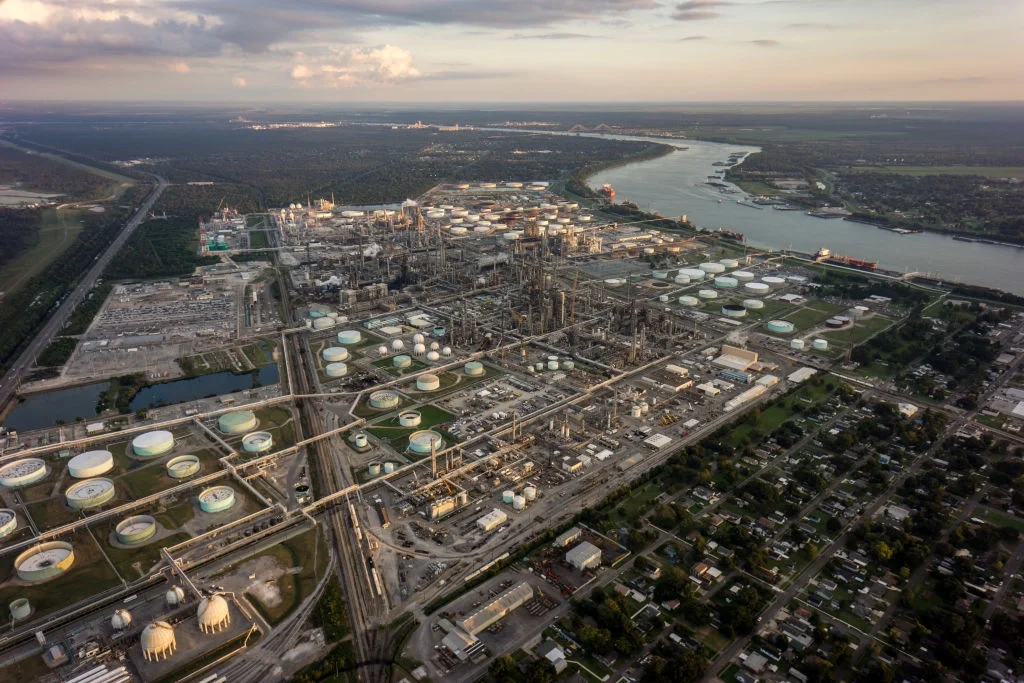
Chemical plants and factories line the roads and suburbs of the area known as Cancer Alley. 'Cancer Alley' is one of the most polluted areas of the United States and lies along the once pristine Mississippi River that stretches some 80 miles from New Orleans to Baton Rouge, where a dense concentration of oil refineries, petrochemical plants, and other chemical industries reside alongside suburban homes. (Photo by Giles Clarke/Getty Images.)
In Louisiana, Lewis pointed to the proposed $10 billion Meta data center in Richland Parish as one example already shaping utility planning. New natural gas generation is under consideration to meet projected demand—extending the same dynamics long concentrated in Cancer Alley into new parts of the state.
“You can change a zoning law. You can pull back a tax incentive,” Lewis said. “But you can’t un-build a power plant.”
And because they happen out of view, they are easier to accept as fixed.
Industrial Expansion, Not Innovation
On the ground, this isn’t a digital revolution—it’s industrial expansion, driven by tech companies, enabled by political leadership, and advancing through the same regulatory and economic playbook long used by the oil and gas industry. As Tennessee Representative Justin J. Pearson told me on A People’s Climate: “We’re not getting the headquarters folks. We’re getting the trash bin.”
“We’re not getting the headquarters folks. We’re getting the trash bin.”
In South Memphis and nearby communities like Southaven, Mississippi, Conner described the data center buildout at a pace that often outstrips both public awareness and regulatory oversight. In some cases, methane gas turbines are deployed simply to get facilities operational faster, instead of waiting for transmission buildout or renewable energy projects to be completed. Diesel generators, often described by companies as “backup” systems, run continuously, adding to the pollution burden in places that have already been managing its effects for decades. “The term ‘backup’ is a little bit misleading,” she said. “Because they’re still running 24 hours a day.”
The scale is just as striking. Facilities can draw enormous volumes of water to cool their operations—sometimes up to 5 million gallons per day for a single large data center—placing additional strain on already stressed local systems. Residents also report persistent noise and air pollution that extend well beyond the footprint of the site itself. A South Memphis local physician recently described rising nitrogen dioxide levels tied to data center turbines as “alarming” and a significant risk to residents’ health. In response, local organizers with Representative Pearson’s leadership are stepping in to track what regulators have not: Memphis Community Against Pollution recently announced a $250,000 investment in air quality monitoring technology, installing sensors across the city to measure pollution levels around the clock.
Thermal drone footage shows unpermitted turbines operating at xAI’s gas plant in Southaven, Miss., nearly two weeks after the EPA ruled such turbines require permits before they can run. (Evan Simon / Floodlight)
Just as significant is how these projects move forward. In many cases, residents and even local officials only become aware of the scale of development after construction is already underway, with key decisions made through filings and approvals that receive little public attention.
“There’s just a lack of information,” Conner said. “And they are moving very, very quickly.”
“What is new is not the pattern, but the speed, and the way it is being framed in popular culture while financed by big tech.”
None of this is happening in isolation. Many of these data centers are being proposed in communities that have long histories of industrial exposure—places where the cumulative impacts of pollution, disinvestment, and regulatory neglect are already part of daily life. What is new is not the pattern, but the speed, and the way it is being framed in popular culture while financed by big tech.
How The Deal Gets Made
When I asked Lewis what utilities are telling commissioners, his answer was direct.
“They’re telling us we have to move fast,” he said. “Or we’re going to exclude our communities from economic development.”
That argument compresses the timeline for decision-making and narrows the range of acceptable responses. It suggests that the question is whether to accept growth, not what kind of growth is being proposed, or who ultimately benefits.
But utilities are not just responding to demand—they are responding to a specific kind of customer. Data center companies like Meta, Amazon, and Google require enormous, continuous amounts of electricity to operate. When they enter a region, they approach utilities with that demand, often backed by long-term contracts.
For utilities, those requests represent an opportunity. Their business model is built on capital investment: utilities propose new infrastructure, regulators approve it, and the costs are then recovered through rates, with an added return for shareholders. That means households and businesses are not just paying for electricity—they are financing the buildout itself. A portion of every bill flows directly to utility investors, totaling billions of dollars in profits each year based on publicly reported financial data.
“The more that they can convince a large load to let them be the owner and operator,” Lewis said, “the better it is for their shareholders.”
In practice, that means data centers create a powerful incentive to build quickly and at scale. Utilities gain new infrastructure to finance and earn returns on. Companies secure the energy they need to operate. And political leaders point to jobs and investment as evidence of economic growth.
Since speed is prioritized, the types of projects that move forward tend to follow a familiar pattern.
“We know utilities are going to favor natural gas,” he said.
Natural gas plants are faster to build, easier to permit, and cheaper to finance within existing regulatory frameworks. They are also routinely framed as a cleaner alternative, positioned as a step forward from coal. But natural gas is still a fossil fuel. While burning natural gas can produce fewer direct emissions than coal, it also releases methane—a far more potent greenhouse gas—across its extraction, transport, and use. Those leaks, combined with long-term infrastructure buildout, make it anything but clean.
The Jobs Promise, RecycleD
In Louisiana, those dynamics are embedded in a much longer history. In Cancer Alley—where petrochemical facilities that produce the feedstocks for plastic have shaped both the economy and public health for generations—Lewis sees clear parallels to what’s unfolding now. When I asked him directly, he didn’t hesitate.
“Absolutely,” he said. “What we’re seeing is the same talking points and the same type of persuasion that we’ve seen used on vulnerable and at-risk communities in Louisiana,” he said. “They’re arguing that this industry is better and it’s not going to pollute. They’re saying how these are computers, and are going to be high-wage, high-quality jobs unlike the petrochemical plants.”
For decades, industrial expansion in the state has been justified by fossil fuel corporations and political leaders through the language of jobs and economic development. And for many families, those jobs were real. But the framing has always come with a condition.
“It’s created this false narrative, that people are having to make a decision between whether they are economically secure or whether they’re healthy.”
“It’s created this false narrative,” Lewis said, “that people are having to make a decision between whether they are economically secure or whether they’re healthy.”
That tradeoff has never been evenly distributed. The economic benefits cluster in one place, while the environmental and health burdens fall on Black communities that have had little say in how these decisions are made.
What’s different this time is how thin that promise of jobs actually is. Data centers can require large construction workforces in the short term, but once operational, they employ relatively few workers to maintain highly automated systems. The long-term footprint is infrastructure, not employment.
So Who Ultimately Pays for AI’s Energy Demand?
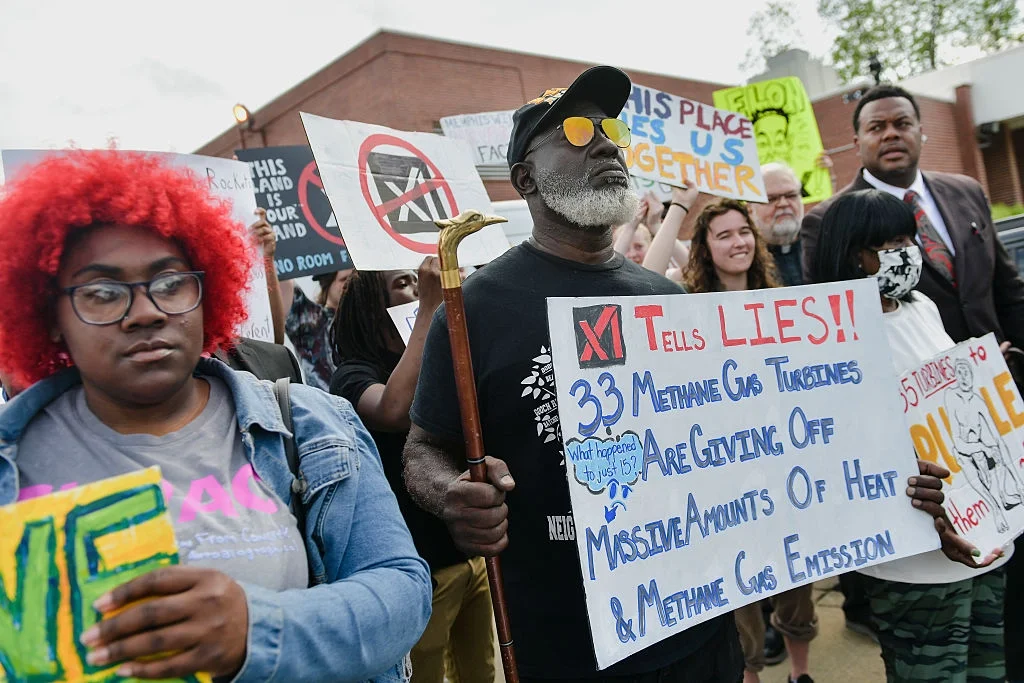
Demonstrators rally in opposition to a plan by Elon Musks's xAI to use gas turbines for a new data center ahead of a public comment meeting on the project at Fairley High School in Memphis, TN on April 25, 2025. (Photo by Brandon Dill for The Washington Post via Getty Images)
The question of cost is where the story stops being abstract. AI is sold as clean, seamless, everywhere at once. The grid is how it actually operates, rooted in specific places, governed by specific decisions, and paid for by specific people.
Publicly, the message is straightforward: data centers will pay their own way. Residents won’t see higher bills. The benefits will outweigh the risks. And in the short term, that may even appear to be true.
“Data centers coming online today probably will not affect your bill right away,” Lewis said. Utilities build long-term infrastructure based on short- to medium-term demand, recover those costs over time, and distribute the risk across ratepayers. The benefit is immediate and highly visible—jobs, flashy announcements, and investment.
But the cost is slower, quieter, and much harder to trace back to the original decision. That’s why the timeline that matters isn’t measured in months or even election cycles. It’s measured in decades.
In Louisiana, utilities are already building new natural gas plants to serve data centers tied to companies like Meta. Those companies may sign contracts for 15 years. The infrastructure being built to support them is expected to last 30 to 40 years.
“The risk of affordability is not today,” Lewis said. “It is what happens after 15 years.”
That gap—between the life of the contract and the life of the infrastructure—is where the burden begins to take shape. If the company leaves, or renegotiates, or simply no longer requires the same level of power, the cost does not leave with it. It stays in the system, attached to assets that still need to be paid off.
“Now the people of Louisiana are left on the hook,” Lewis said.
This is not a loophole. It is how the system is designed, where utilities build long-term infrastructure, and ratepayers are responsible for paying it off — even if the demand that justified it disappears.
At the same time, the financial structure of utilities only captures part of the equation. Because even as costs are deferred on paper, they are already being absorbed in other ways.
“There is an immediate cost, which is people’s health. And then there is a generational cost. Oftentimes, this is how you create cancer clusters.”
The expansion of fossil fuel infrastructure tied to data centers brings increased exposure—air pollution, water contamination, cumulative harm that builds over time. These are not future risks. They are present conditions, layered onto communities that have already spent decades managing the consequences of industrial development.
“There is an immediate cost, which is people’s health,” Conner said. “And then there is a generational cost. Oftentimes, this is how you create cancer clusters”
Those impacts rarely show up in the same calculations that justify new projects. They are harder to quantify, easier to delay, and often excluded from the official record altogether. But they are central to how these decisions are experienced on the ground.
The cost of AI is not just what shows up on a utility bill. It is what accumulates in bodies, in our water, air, and soil — and in places that have long been treated as expendable.
AI Needs A Warning Label
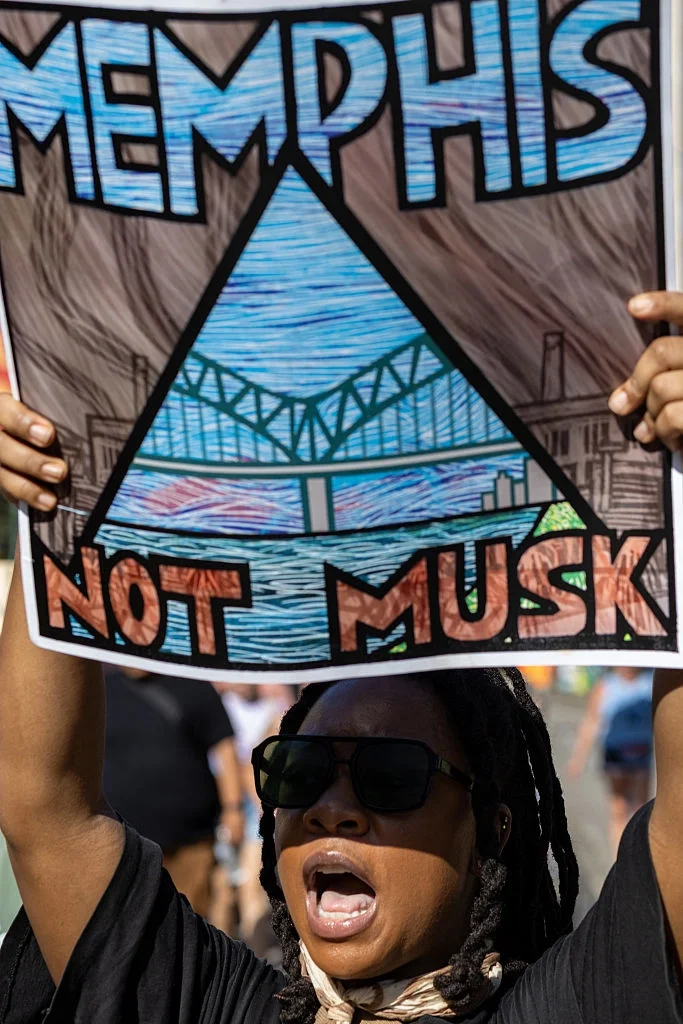
A protester holds up a sign in opposition to xAI during a protest march through downtown Memphis, Tennessee, in opposition to the increase of federal law enforcement agents, the coming deployment of the National Guard and xAI, an AI company owned by Elon Musk that is locally based, during the "Get Out of Memphis" protest on October 4, 2025. The protest was organized by Tigers Against Pollution, a student led activist group based in Memphis. (Photo by Austin Johnson / AFP) (Photo by AUSTIN JOHNSON/AFP via Getty Images)
There is a long history of industries selling a story of their product as safe, modern, necessary. Tobacco once claimed to be healthy. Coal was marketed as clean. And plastic is being sold as the answer to convenience. None of that messaging is accidental. It’s backed by massive public relations campaigns designed to shape how the public understood risk, before the full cost became visible.
Conner put it plainly: using AI needs a warning label.
Artificial intelligence is being introduced as efficient, even “green.” But what’s expanding to support it is not new. It is rooted in the same extractive systems that have long defined petrochemical production—where land, energy, and communities are treated as expendable, and the costs are pushed outward. What’s changing is not the system, but how quickly it is being scaled.
The difference is not just how early we are in the story, but how much is already being set in motion. With tobacco, plastic, and fossil fuels, the harms were obscured until the systems were firmly in place. Here, the warning signs are already visible—and in many places, the infrastructure is already being permitted, financed, and built. At the same time, communities are pushing back in real time, challenging projects before every decision is fully locked in.
In Louisiana, Tennessee, Missisisspi, and across the South, people are showing up—in regulatory hearings, in town halls, in community meetings—to challenge the terms under which this infrastructure is being built.
Conner is organizing nationally to make those patterns visible. Lewis is pushing from inside the system to force those decisions into the open.
The infrastructure is moving quickly — but so is the response.

Shilpi Chhotray is an award-winning journalist, advocate, and media strategist covering environmental justice and climate politics. She is the co-founder and president of Counterstream Media and the host of Webby-nominated A People’s Climate for The Nation.
Through her storytelling and media work, she interviews frontline organizers, movement leaders, and legal experts across the United States and internationally, examining how communities challenge environmental injustice and reshape public conversations about climate and democracy. Her work has appeared in The Guardian, The Nation, Prism, and Nonprofit Quarterly. She is also the executive producer of Peace & Riot.
Peace & Riot is made by real people — not AI.
Journalists, photographers, editors, and contributors doing original reporting from the frontlines.
That work is under threat. Newsrooms are shrinking. AI is training itself on what journalists have already built, and replacing it with something hollow.
Independent, human storytelling is being squeezed from every direction. If you value work built on lived experience, not stolen data — help keep it alive.
Donate to power more issues like this one.