
Summer 2026
America's Trash Can
Toxic Prisons and the Calculus of Disposability
By Adam Mahoney
This story was co-published and supported by the journalism non-profit the Economic Hardship Reporting Project.
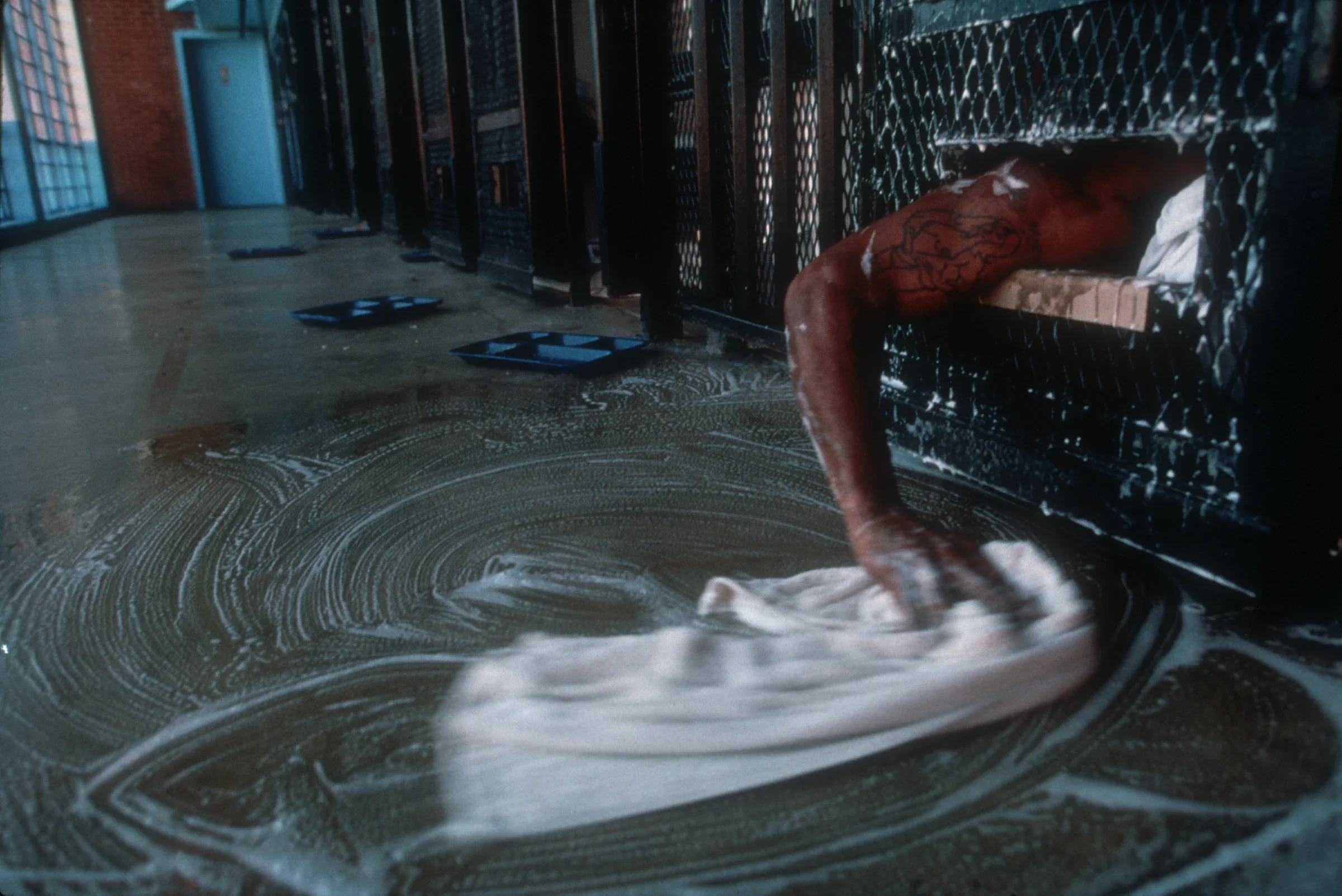
A prisoner in Beaumont, TX attempts to clean up the area around his cell after it was flooded with sewage from the tier above. Stopping up toilets in the cells is a form of protest in prison. (Photo by Andrew Lichtenstein)
This story was produced by Counterstream Media and co-published with Nonprofit Quarterly as part of the #WeTheCivic national narrative intervention.
A CORRUPT CALCULUS
The first time I walked into a prison, I was 20 years old. It was before sunrise when I left on the 55 mile journey deep into Chicago’s Southwestern suburbs. The drive out of Chicago always felt endless, past the bungalow neighborhoods thinning into strip malls and industrial yards, past the freight terminals and the truck-loading docks squatting at the edge of the city.
Then the sprawl released you, and you were in something else: the flat open country of the Illinois prairie, where highways and hundreds of trucks cut straight through corn-stubbled farmland. The fields were also dotted with water towers, grain elevators, and a seemingly never-ending count of water-guzzling Amazon fulfillment centers.
“What gets built beside and whose land absorbs the fallout—are rarely accidents. They are the product of 250 years of state-sanctioned choices about whose communities are worth protecting and whose are available for sacrifice.”
I was making the drive to participate in the prison's first “inside-out” program, where I joined nine other ‘outside’ undergraduate students in participating in writing workshops with incarcerated students at Stateville Correctional Center. I imagine that many of the tens of thousands of people who made this same drive for decades to visit their loved ones did so without stopping to ask who decided what goes where. I had not yet learned to ask that question either. I also didn’t have language yet for the throughline connecting the freight yards, warehouses, and oil terminals to the inside of the prison, where I walked by sign after sign reading the words “toxic” and “danger.” I was beginning to understand, however, that the decisions behind that arrangement—what gets built beside and whose land absorbs the fallout—are rarely accidents. They are the product of 250 years of state-sanctioned choices about whose communities are worth protecting and whose are available for sacrifice.
This calculus did not emerge from nowhere.
For decades, Stateville's water contained nearly twice the federal limit for radium, and the contamination never stopped. By 2022, Illinois officials confirmed Legionella in the facility's water supply—a finding that contributed to the prison's eventual closure.
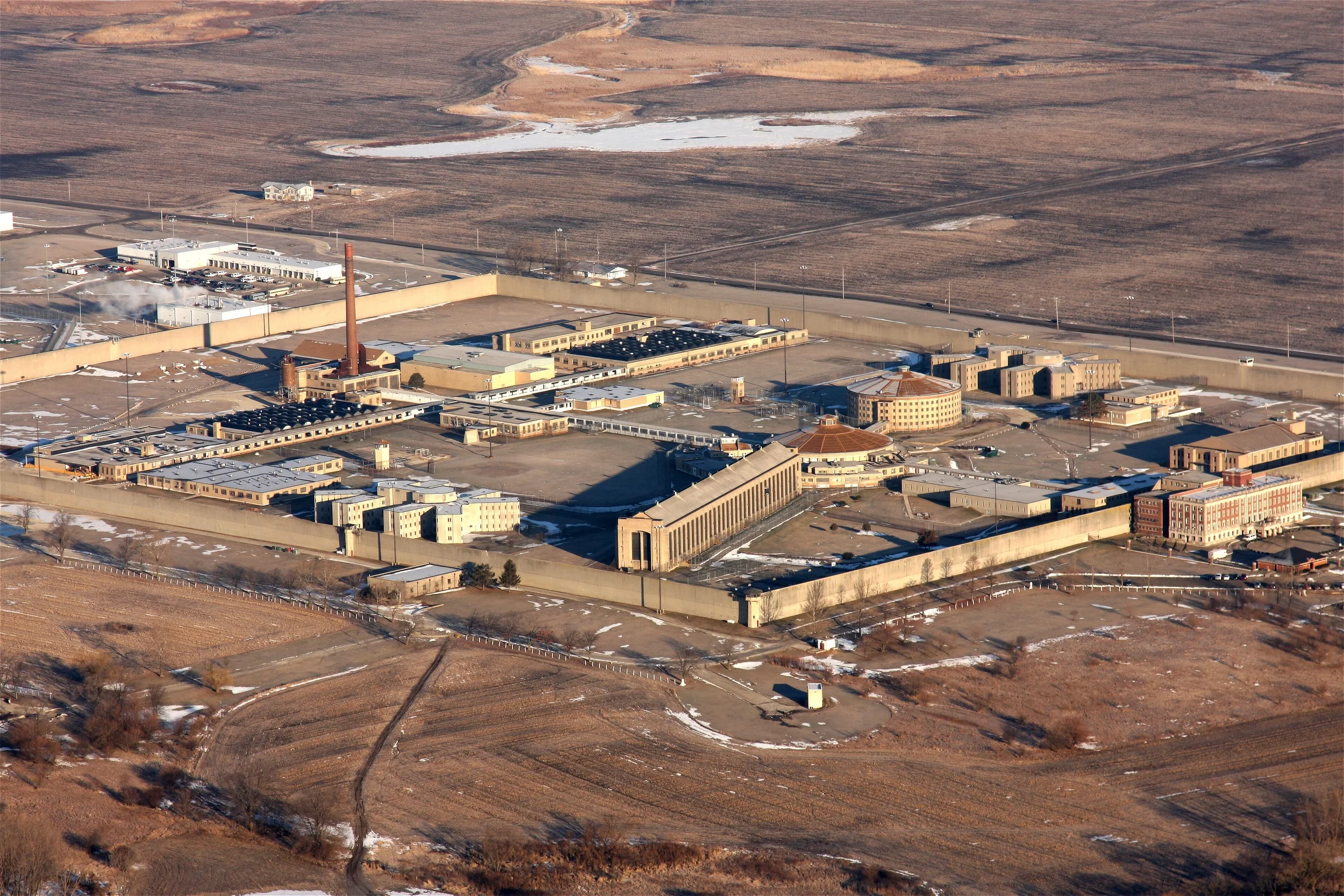
The Stateville Correctional Center in Crest Hill, Illinois, near Chicago.
And then there were the men. Broderick Hollins, a classmate of mine who spent six years at Stateville, was diagnosed upon release with a blood-lead level of 83 micrograms per deciliter—more than eight times the threshold linked to neurological damage—traced directly to the prison's lead pipes. Or my friend Benard McKinley, who was incarcerated there for decades, who told me it often felt like a perpetual sickness was pulsing through the facility's grey walls.
Through moments like this, it became clear to me that the prison and the industrial sprawl around it are products of the same calculus: extract what's deemed useful, discard what isn't, and find the cheapest possible place to hide the remainder.
This calculus has roots in the plantation economy, in convict leasing after the Civil War, in redlining and urban renewal, and in every era of American history when Black and brown communities were deemed expendable, their land available for the taking, and their bodies available for the labor. The ecological crisis unfolding inside and around Stateville was not an aberration in the American story. It is one of its central chapters.
AMERICA’S TRASH CAN
B. Preston Lyles, lead organizer for the Toxic Prisons Campaign of the Human Rights Coalition in Philadelphia, has a shorter name for this arrangement. “Prison,” he told me, “just like the landfill is America's trash can. The imagery of a trash can means: we don't want you back. We don't care about you.”
The trash can idea, he explained, is inseparable from the ecological crisis playing out beyond its walls.
Lyles came to this work through SCI Fayette, the Pennsylvania state prison where he watched friends, neighbors, and loved ones grow sick from contaminated water and coal ash-laden air. He couldn't understand why no one seemed to be connecting the dots between where prisons were built and what was happening to the people inside them. So he started making those connections himself by mapping toxic sites, filing public records requests, and building a campaign that now stretches across more than a dozen states.
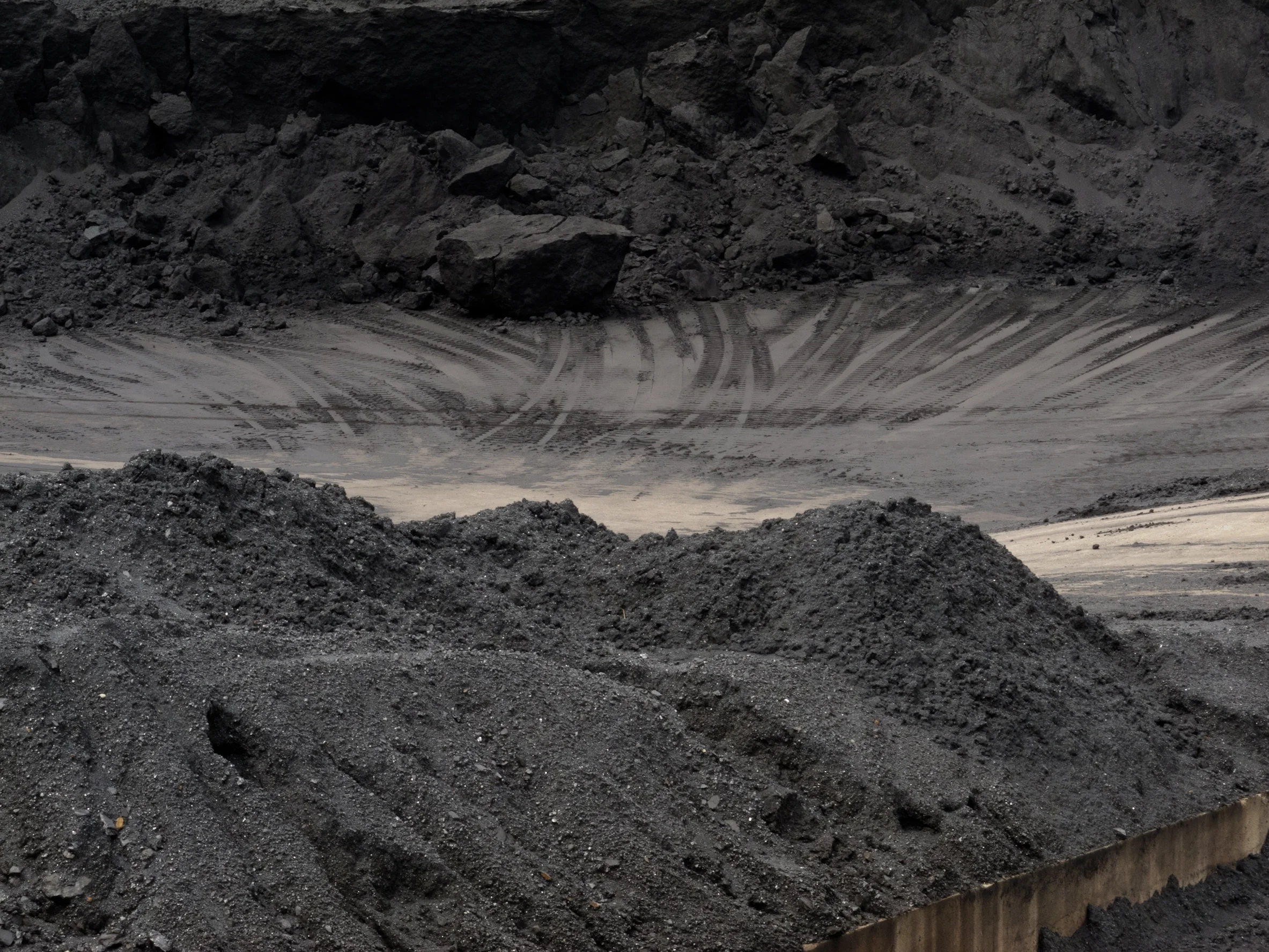
Coal ash, the toxic remains of coal burning in power plants, contains a hazardous brew of toxic pollutants including arsenic, boron, cadmium, chromium, lead, radium, selenium, and more.
The toxics in coal ash can cause cancer, heart disease, reproductive failure, and stroke, and can inflict lasting brain damage on children.
One-third of all state and federal prisons in this country sit within three miles of a federal Superfund site. That is a confession of values, he said, and evidence that the same society that decides where to dump its industrial toxins also decides where to dump the people it has deemed unproductive, dangerous, and a surplus. The two decisions only reinforce each other.
A 25-year long study found that incarcerated people breathe significantly more polluted air than the general public—exposure levels that, on the outside, would trigger federal environmental protections that simply don't apply behind the walls. It is something the federal government is aware of. In fact, my reporting about pollution impacting county jails caught the attention of President Joe Biden’s environmental justice team in 2022, who then pushed the administration to regulate those conditions for incarcerated people. It never happened.
Inside, the poisoned land justifies the lowered standard of care, Lyles explained. The lowered standard of care normalizes the poisoned land. What gets built into culture this way is not just a tolerance for suffering, it is an entire architecture of response that treats harm as a disposal problem rather than a human one, Lyles said.
“It is a way of thinking that says some bodies, some lands, are safe to throw away,” he said.
In practice, that means we will allow oil refineries to dump more toxins in the air than legally permitted, or poor people—both inside and outside the prison walls—to drink contaminated water until they die an early death. It means that the 1994 Crime Bill, which triggered a historic prison construction boom, was never accompanied by any environmental analysis of where those facilities would be sited or what would be in the ground beneath them. It means that the prison industrial complex and the fossil fuel industry have long operated as business partners, with prisons purchasing coal, leasing land from mining companies, and contracting with petrochemical firms for everything from cleaning supplies to industrial manufacturing. After Deepwater Horizon, the largest marine oil spill in the history of the petroleum industry, British Petroleum used prisoner cleanup crews on toxic beaches in Louisiana. Incarcerated people were forced to wear BP logos to conceal their status and many were paid nothing at all as they risked their health.
“But there is a class of people in this country, often Black and brown and poor, who are left with the harms society has tried to disappear because in America, the cheap land and the disposable people arrive at the same address.”
These are policy choices, not inevitabilities. The logic is that we can always build more walls. Dig more sites. Drive further from the city until the thing you're trying not to see disappears over the flat horizon.
But there is a class of people in this country, often Black and brown and poor, who are left with the harms society has tried to disappear because in America, the cheap land and the disposable people arrive at the same address.
SCI Fayette, the Pennsylvania state prison that first drew Lyles into this work, was built in 2003 on land purchased from a coal ash processing company. The state paid $125 million for 238 acres sitting atop a coal waste dump.
TOXIC PRISONS ON TOXIC LANDS
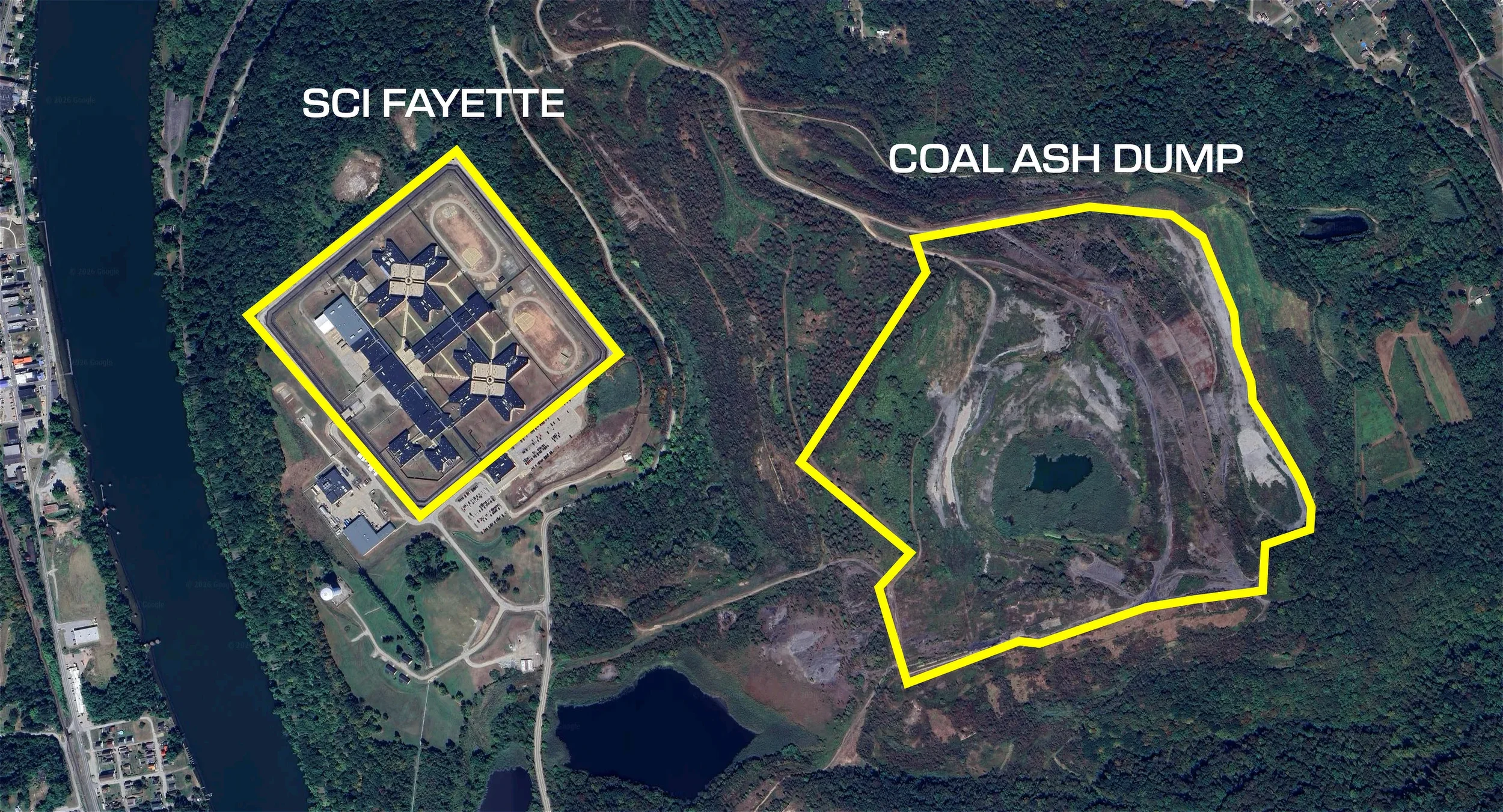
Satellite view of SCI Fayette and its proximity to a coal waste dump.
Coal ash—the toxic residue left after burning coal for energy—contains heavy metals like arsenic, lead, mercury, and chromium, as well as radioactive elements. When unmanaged, these toxins leach into groundwater or are inhaled as dust, posing severe risks to human health. The prison industry's relationship with coal is not incidental: facilities like Fayette were deliberately sited on contaminated industrial land precisely because that land was cheap, and because the people who would live on it had no political recourse to object.
The day-to-day reality at Fayette reflected this arrangement in brutal detail. According to testimony gathered by Lyles's campaign and documented in film, incarcerated people washed their clothes in water so contaminated it smelled of urine and were then expected to drink that same water. Guards and guard dogs were provided bottled water. The people serving sentences were not.
Within the first years of opening, 11 deaths were reported, followed by escalating cancer diagnoses that went unaddressed for months—sometimes years—because, as Lyles put it, “the healthcare in prisons often tells people that what they're suffering is not important. And so by the time these humans are paid attention to, it's often too late.”
The Toxic Prisons Campaign has responded by doing the work that state agencies and public health departments have refused to do: mapping the overlap between incarceration sites and environmental hazards, supporting formerly incarcerated people in documenting their health impacts, and pressuring state legislatures to conduct environmental impact assessments before any new prison construction. They have also partnered with groups like the Abolitionist Law Center to file public records requests and pursue litigation. They are building an evidentiary record that the harms at facilities like Fayette are not accidents but foreseeable consequences of deliberate choices.
Research has already confirmed that Fayette is not an anomaly. Detention centers are more likely to be located near toxic sites than any other land use category like housing or commercial corridors, and disproportionately are sited in communities of color.
“The acquisition of toxic lands in obscure locations is part of the allure,” Lyles said, “because society has deemed that these people are throwaways. The government doesn't care that the lands are toxic—except that it's cheaper to purchase.”
LEGACIES OF CONTAMINATION
To understand this logic, you don’t have to go too far back. “We go to enslavement. We go to those times just after the Civil War, where they captured Black men and put them in prison labor camps or leased them to corporations,” Lyles said. “That is the history of it. And it is still very present in the 13th Amendment—slavery has been abolished, except for those who are incarcerated.”
After emancipation, Southern states rapidly enacted Black Codes, which were laws that criminalized the Black existence in America. You could be imprisoned for being unemployed or for something as simple as walking down the “wrong street.” It effectively re-enslaved freed Black men through the justice system.
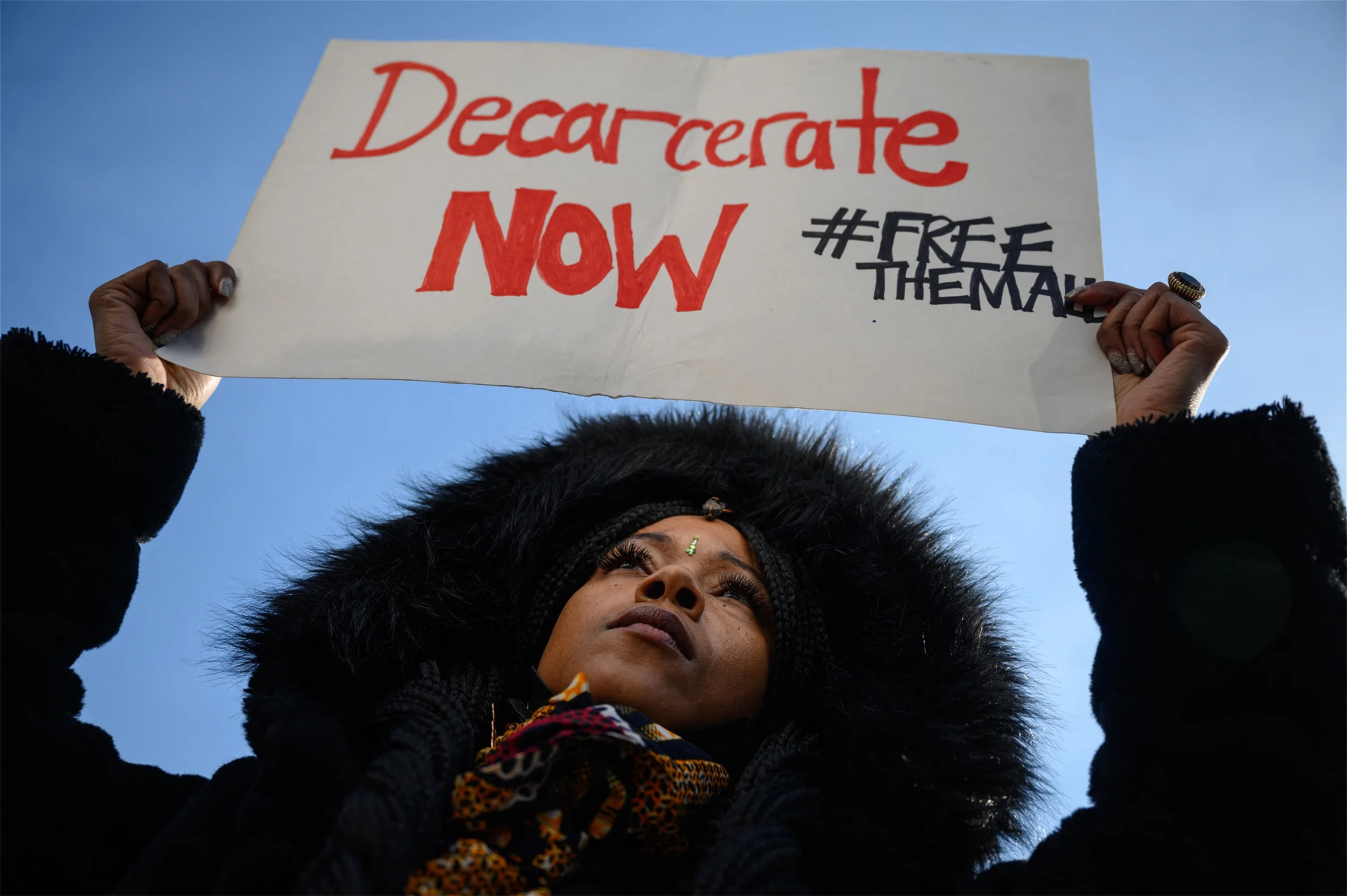
Dr. Victoria A Phillips, co-chair of the NYC Department of Corrections Young Adult Task Force, holds a placard reading "Decarcerate Now" during a rally in solidarity with inmates on hunger strike, at the entrance to the Rikers Island jail complex in Queens, New York on January 13, 2022. (Photo by ED JONES/AFP via Getty Images)
Under convict leasing, states then rented incarcerated people to railroads, coal mines, and plantations, generating revenue while providing industry with coerced free labor. These arrangements were ecologically as well as racially brutal. Black men worked in mines and on industrial sites under conditions that would not have been tolerated for any free worker. The environmental degradation of incarceration did not begin with mass incarceration in the 1970s and 1980s. It began the moment the carceral system was built to replace slavery.
Michelle Alexander, the famed author of The New Jim Crow, recognizes the same continuum. “We have not ended racial caste in America,” she writes. “We have merely redesigned it.”
The redesign is ecological as much as legal. The throwaway people are placed on the throwaway land—and the throwaway land, in turn, is made more toxic by their presence. A 2020 study found that growing incarceration rates correlate with increases in industrial emissions and the use of toxic chemicals, driven by the expansion of prison supply manufacturing. The prison is poisoning both the land and our culture.
“As long as Black bodies are illegitimately chained, as long as Black bodies are caged, then the hope of healthy environments—that hope is impossible.”
This is the thread the environmental justice movement has been slow to follow into the carceral system—the recognition that you cannot have a healthy environment while Black bodies remain, in Lyles's words, “viewed as waste.”
“As long as Black bodies are illegitimately chained, as long as Black bodies are caged,” he told me, “then the hope of healthy environments—that hope is impossible.”
The drive I used to take to Stateville, down I-55, the oscillation between farm and warehouse and detention wall, is not a series of separate land-use decisions. It is one decision, made continuously, about whose life is worth protecting and whose is not. These decisions are made by legislators who fund prison expansion over public health infrastructure, zoning boards that place no environmental restrictions on correctional facilities, industries that lobby for access to incarcerated labor, and by a broader culture that has accepted the idea that some people simply belong behind walls, on poisoned ground, and out of sight.
ABOLISHING THE SYSTEM
The path forward demands something beyond reform, visionaries have argued. Angela Davis, in Are Prisons Obsolete?, argues that reform-only movements help produce the idea that nothing lies beyond the prison—that the cage is permanent, thus making only the conditions inside negotiable.
Lyles is unambiguous, too. “We only want to see improvements on the way to the cessation of the system. Improve conditions now, on the way to abolishing the system.”
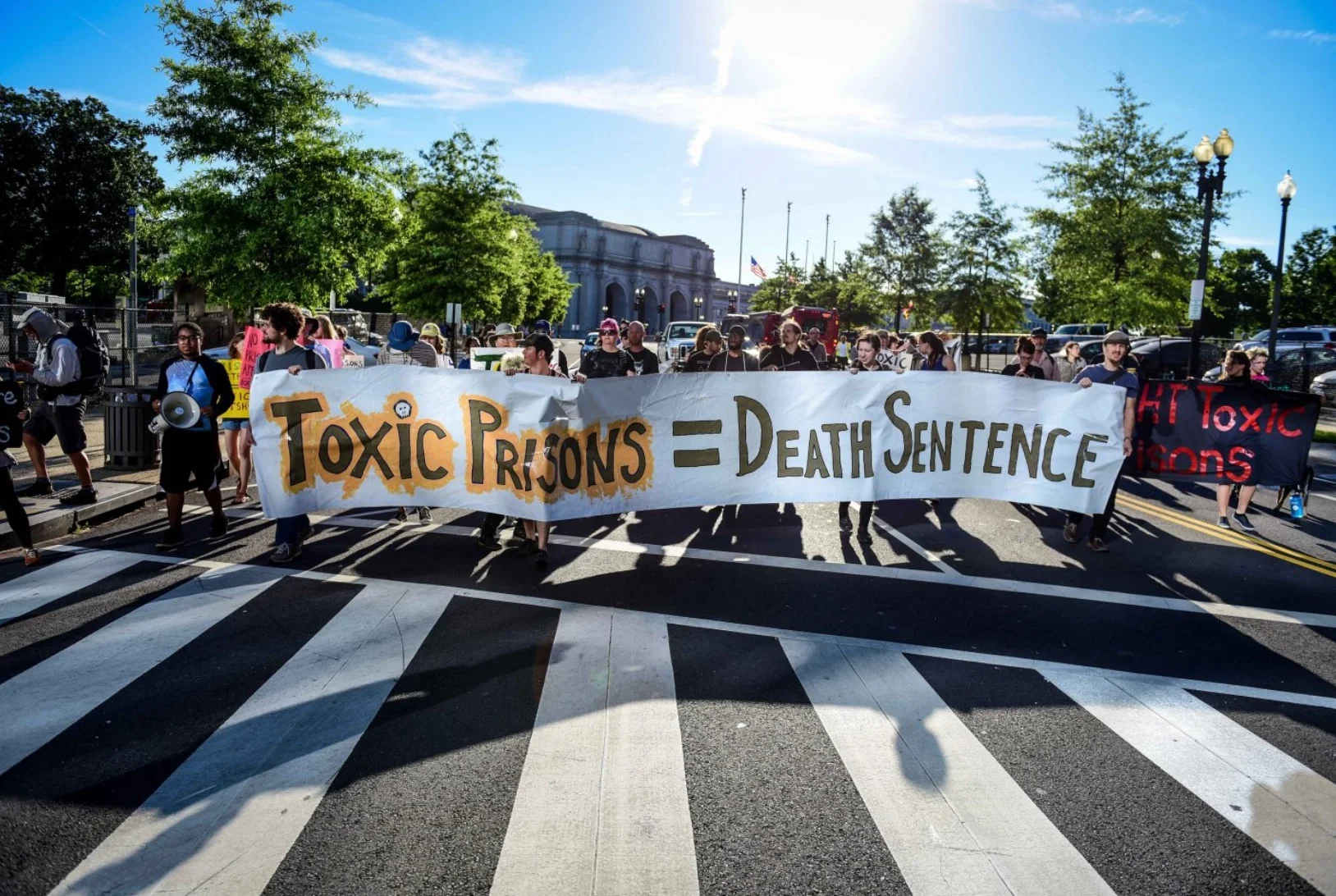
Photo by Jordan Mazurek
“That is the work: not a better cage, but a return of the land to the people it was taken from, so that both might begin, slowly, to recover.”
When I asked him to imagine what those 238 acres in Belle, Pennsylvania might become once closed, his answer was immediate: “Housing, gardens, community spaces, maybe a solar farm. Two hundred and thirty-eight acres is a lot of land to do a lot of good things on.”
That is the work: not a better cage, but a return of the land to the people it was taken from, so that both might begin, slowly, to recover.
This vision connects to broader movements for land back and reparative justice that are reimagining what formerly carceral and industrial spaces can become. In Kentucky's Letcher County, a coalition backed by the Appalachian Rekindling Project has been organizing around a proposed federal prison site, arguing that the land, which was long stripped by coal extraction, should instead be returned to Indigenous stewardship and community use. In Louisiana, the GrowingChange History Project has been documenting how formerly incarcerated people and their families are reclaiming land tied to histories of convict leasing, turning sites of extraction into sites of healing.
This work is “not about making minor reforms and plodding along in the same direction,” Alexander has said. “It's about mustering the courage to have a major reassessment—to reckon with our racial history, and build a movement rooted in the awareness of the dignity and humanity of us all.”
In simple terms, “the cost of environmental racism is unsustainable,” Lyles said.
That first morning, driving south toward Stateville to meet with incarcerated students, I didn't know any of this the way I know it now. I only knew what I saw: the wall rising out of flat Illinois earth, abruptly and without apology. It felt as if it had always been there. It is as if the prison, contamination, and arrangement of sacrifice and profit were natural features of the landscape, as inevitable as the prairie itself. That is precisely what America's system of disposability requires us to believe: that it could not be otherwise. But communities across the country are refusing that myth. They are mapping the contamination, naming who is making the decisions, reclaiming the land—and insisting, with growing force, that what was built by human choices can be unmade by them, too.

Adam Mahoney is a Black writer. At Capital B News, he covers environmental justice, climate change, and racial displacement in America. He is the co-author of The Problem with Plastic (with Judith Enck, The New Press) and of Notes on Finding Home (Haymarket Books, forthcoming). Adam’s reporting has taken him to over 20 states and five countries. He lives in New Orleans, Louisiana.
Storytelling that challenges America’s colonial roots
Peace & Riot brings you stories from the frontlines.
From the activists who pioneered the modern environmental justice movement, to the Indigenous organizers defending their sacred lands, to the agricultural laborers fighting for dignity—we’re a home for the people and movements that have always pushed this country closer to its ideals.
Keep our work alive with a donation of any size.