
SUMMER 2026
Beyond The Cowboy
Human-Horse Solidarity Across Time
By Bitter Kalli
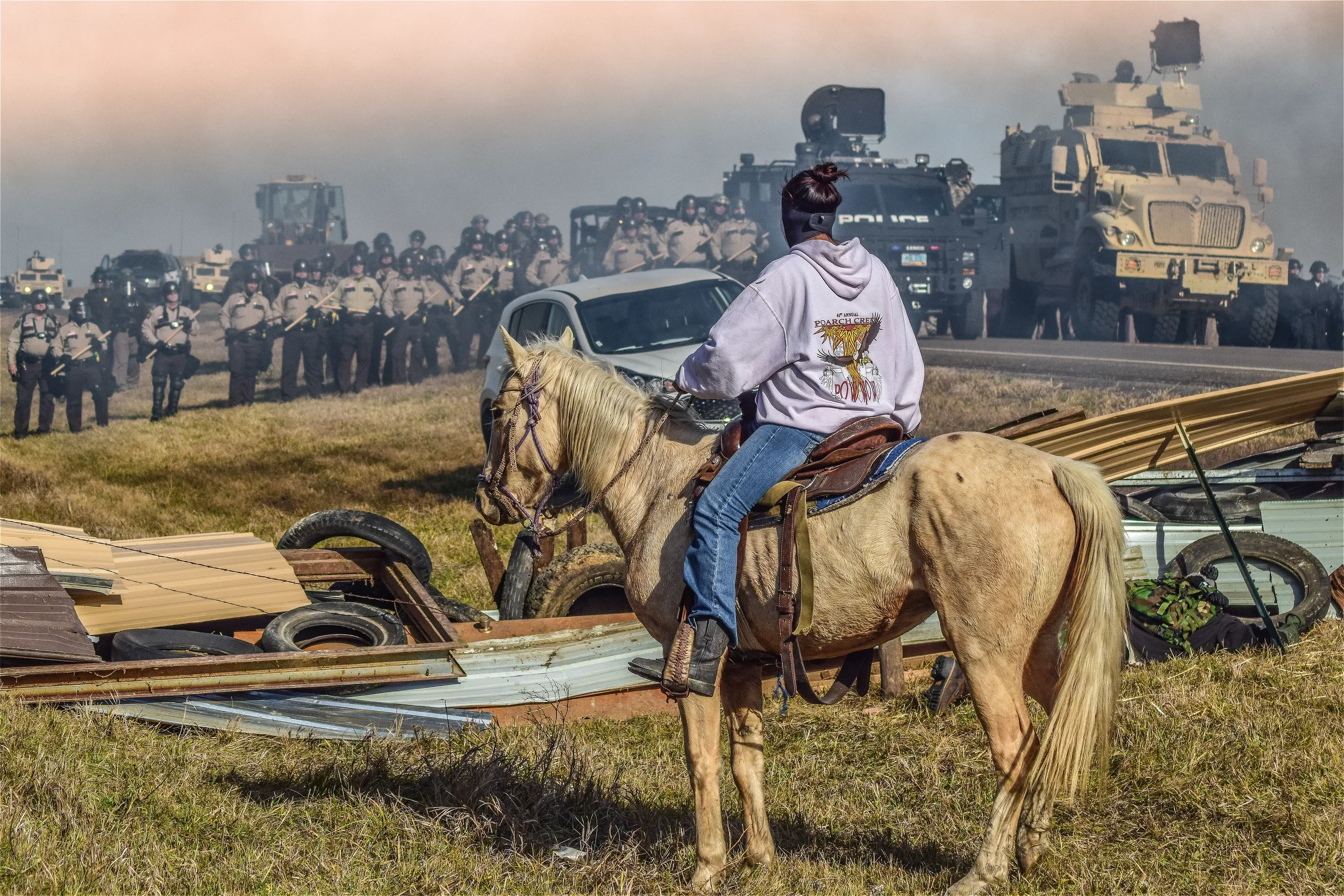
“Defend the Sacred.” Standing Rock, Cannon Ball, North Dakota, 2016. Ryan Vizzions.
This story was produced by Counterstream Media and co-published with Nonprofit Quarterly as part of the #WeTheCivic national narrative intervention.
COWBOY MYTHOLOGIES
In January 2026, the Department of Homeland Security launched a recruitment ad campaign across social media. In one ad, a cowboy on horseback rides in front of a sweeping mountain range, while a B-2 bomber is visible in the sky overhead. The song “We’ll Have Our Home Again”—popular in online neo-Nazi communities—plays in the background.
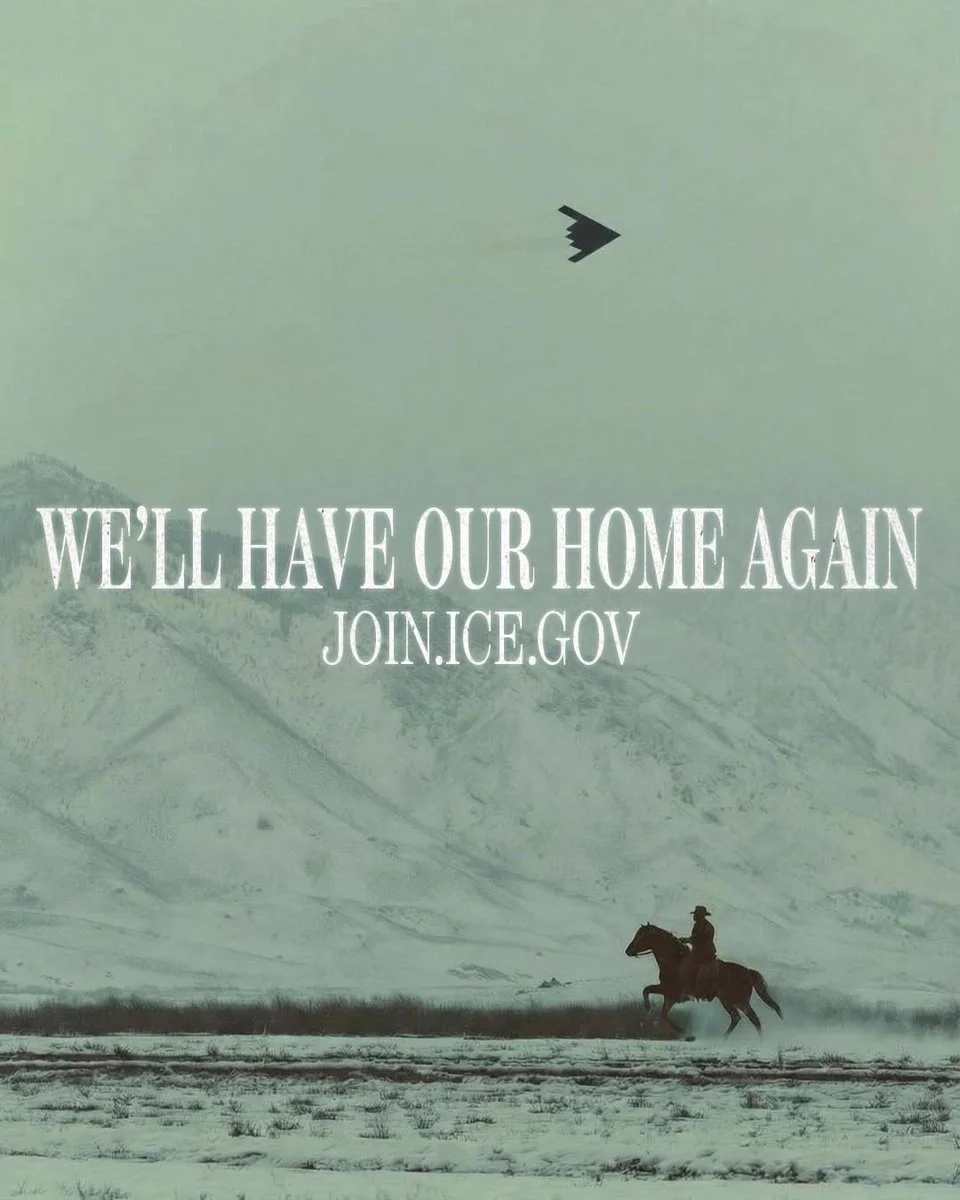
An ICE recruitment ad that was posted by Homeland Security on X on January 9, 2026.
This was not the first time a U.S. government department turned to cowboy culture or aesthetics while recruiting people to police the borders. In 2025, journalists discovered that U.S. Border Patrol was spending $15 million over five years in partnerships with professional rodeo organizations. Competitors at Professional Bull Riders league events wear jerseys that read “Protected by U.S. Border Patrol.” To those who have been exposed to the symbolism of American nationhood, these connections may feel familiar; horses and cowboys have long been associated with the practices of whiteness, masculinity, and patriotism that pervade America’s horrific border regime. However, this is not all that a horse or a cowboy can be.
While horses have been conscripted into the work of American empire, they also carry alternate histories, formed through centuries of entanglement with Black and Indigenous life. The 250th anniversary of the Declaration of Independence has prompted collective reflection about the viability and legacy of a haunted colonial project. As always but perhaps especially now, attending to the equine histories of Turtle Island can give us crucial perspectives on the ecologies of land, labor, and resistance that have shaped our political present.
HORSE-HUMAN HISTORIES
“American they said + + but Horse I dreamed/, and Horse became”
So begins Mojave poet Natalie Diaz’s Alchemy Horse, a physical and cosmic narrative featuring a speaker who refuses the call of “America…Hoard of Property” and defines themselves instead through a Native desert landscape of camel bones and flash floods, pale desert grasses and limestone. These opening lines describe a phenomenon that has been central to Black and Indigenous life since long before this country’s genocidal beginnings: the ways our relationships with horses offer us forms of kinship and embodiment that exist beyond the reach of capitalist mythmaking.
Wild West Cowboy
How did the dominant image of the white, male cowboy come to be? The answer can be found at the confluence of U.S. expansionism and mainstream media.
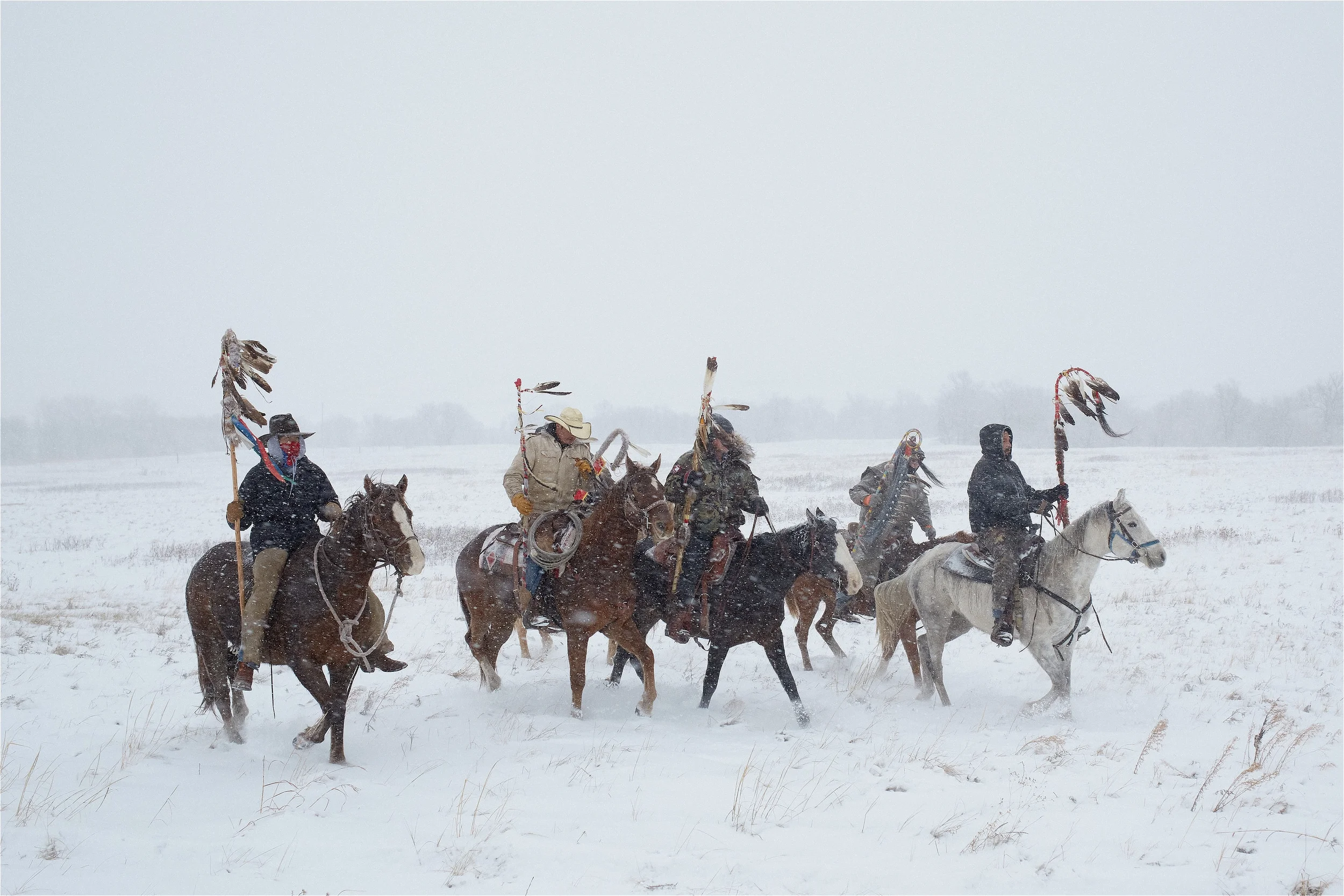
Cavaliers Lakotas, Pine Ridge Indian Reservation, South Dakota, USA 2019. Photography by Zen Lefort / MYOP.
Cowboy culture in the U.S. emerged from Black and Indigenous horse riders. Some of the earliest cowboys in the Americas were vaqueros, Indigenous Mesoamerican riders who managed ranches for Spanish conquistadors in Mexico and throughout Latin America. As the Spanish expanded their empire in the eighteenth century, vaqueros herded cattle and tended horses, playing a central role in agricultural economies. Many of the garments and riding techniques used by vaqueros were later adopted by the cowboys of the Wild West. Cowboy culture was also built by enslaved Black riders who trained horses and drove cattle on plantations. After the Civil War, many of these riders were hired as cowhands by the same white ranchers who had long depended on their labor.
The westward expansion of the United States occurred through the mass displacement and genocide of Native peoples. Laws like the 1862 Homestead Act incentivized white settlers to establish residency in Native territory. The concept of Manifest Destiny, which held that westward expansion was the god-given right of white American settlers, was a prevailing political attitude of the nineteenth century.
During this time of widespread land theft, writers began to create the figure of the Wild West cowboy that we know best today: the dashing, white, morally virtuous man galloping across the open plains. These writers published novels that romanticized the “gritty” western life for readers back east, creating many of the tropes associated with the Wild West today. One work that was influential in creating the pop culture cowboy was the novel The Virginian by Owen Wister, published in 1902. The novel is considered a landmark work in the Western genre, and contains many of the elements (such as shootouts, revenge, and vigilante violence) that became commonplace in later cowboy media. As Hollywood films brought colonialist fantasies to the silver screen, exporting such narratives around the world, fictional cowboys like The Lone Ranger and The Man With No Name helped shape the popular imagination of what America was and could be.
“Exploring the lesser known histories of horse-human relationships in the U.S. means to learn from crucial lineages of land stewardship and community building, and to explore models for how we might live, imagine, and take action together.”
As Dionne Brand writes in Salvage: Readings from the Wreck, film and radio were the main forms of media used to spread American cultural propaganda in the post-World War II era, when the U.S. was replacing Great Britain as a major imperialist power. Through these mediums, the past was rewritten. The racially diverse, polyvocal histories of the American West were flattened in favor of a narrative that served the aims of U.S. empire. Exploring the lesser known histories of horse-human relationships in the U.S. means to learn from crucial lineages of land stewardship and community building, and to explore models for how we might live, imagine, and take action together.
Fugitives
Since the first decades of plantation slavery in the United States, horses have played a vital role in Black people’s freedom practices. Enslaved Black people labored alongside horses in the field, and were often categorized together with agricultural animals in the ledgers of slaveholders. Many Black people were responsible for the daily care of horses on the plantation. In addition to doing the work of stablehands and grooms, enslaved people were also among the first jockeys in the United States. The modern racing industry emerged from rural horse races in which Black jockeys rode for the entertainment of the white landowning class. Because of their speed and the many ways their lives were intertwined with those of Black people, horses were frequently a part of escape plans for enslaved people fleeing the plantation.
Throughout the eighteenth and nineteenth centuries, slaveholders regularly took out ads in local newspapers asking readers to be on the lookout for escaped slaves. The ads featured descriptions of the fugitives, and many also included descriptions of the horses who had accompanied them on their flight to freedom. It was common for enslaved people to steal horses on their journey northwards, sometimes riding them part of the way before traveling by foot, boat, or carriage.
Horses appear in many slave narratives, both as instruments of policing and terror when ridden by slavecatchers, and as freedom collaborators. Because horses have labored under capitalism alongside enslaved and working-class people, they could be found at every stage of the fugitive’s journey, from the plantation to the small-town stable to the streets of Northern cities. In the 1849 Narrative of the Life and Adventures of Henry Bibb, An American Slave, Written by Himself, the writer recounts his escape from a Kentucky plantation to Canada. He describes running on foot before coming across a field of horses. Before attempting to catch one of the horses, he fashions a bridle out of a piece of grapevine. For a fugitive slave like Bibb to steal a horse—“property” stealing “property”—was to disrupt the systems of labor and value that the plantation economy created.
Mounting Resistance
Throughout U.S. history, horses have also played a role in Black and Indigenous political movements and land sovereignty projects.
In 1873, Frederick Douglass gave a speech titled “Agriculture and Black Progress” to recently freed Black farmers. In this speech, he acknowledged that slavery had produced mistreatment of agricultural working animals, and entreated the audience to do things differently in their new lives. He told them that “it should be the study of every farmer to make his horse his companion and friend,” stating that “a horse is in many respects like a man. He has the five senses, and has memory, affection, and reason...” Throughout the nineteenth and twentieth centuries, in free Black towns and on Black-owned farms, horses and people worked together to create new ecological relations beyond the violent labor relations of slavery.
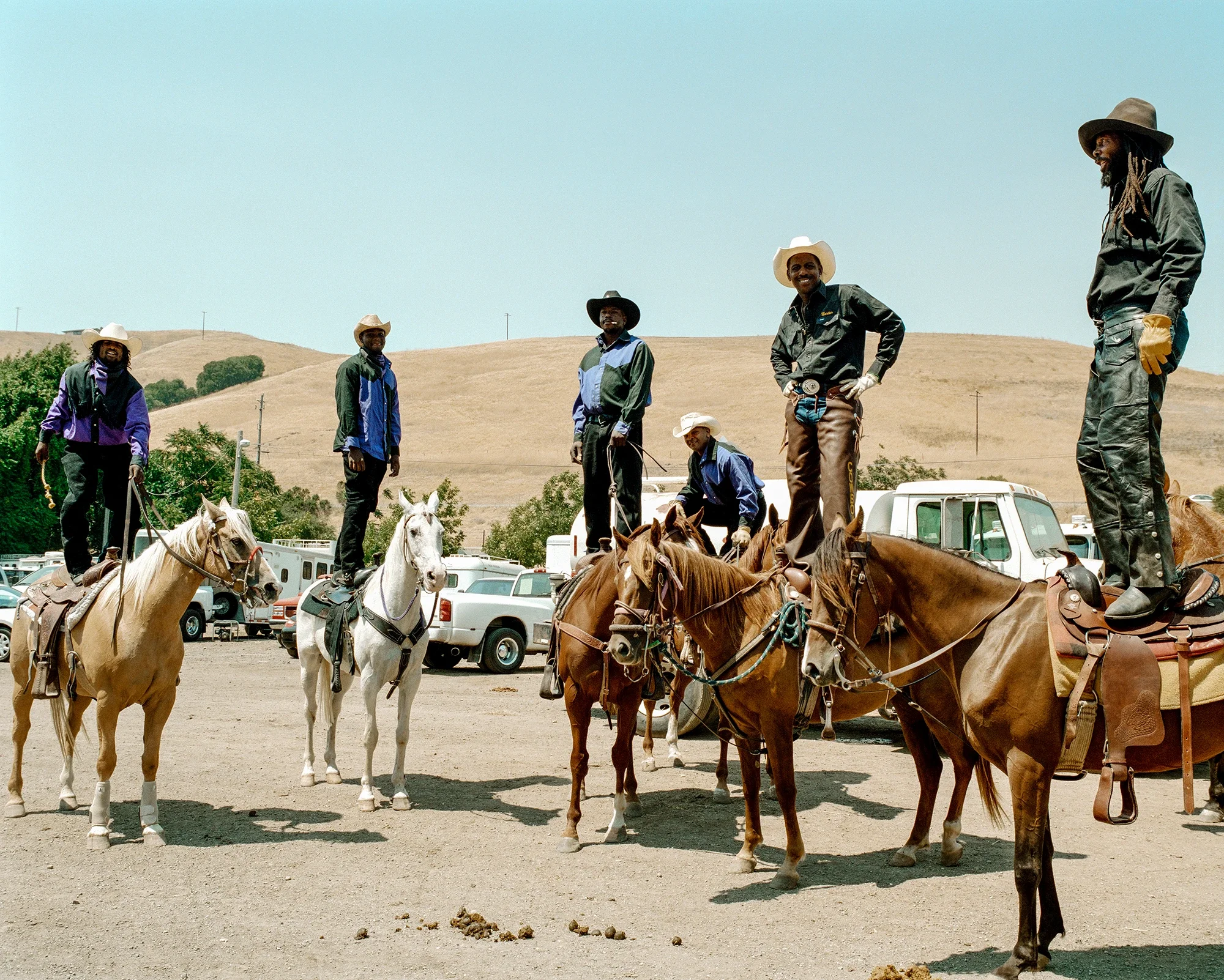
Bill Pickett Invitational Rodeo, Oakland, California 2008. Joseph “Dugga” Matthews (far right) stands on his horse in 2018 with a group of riders from Stockton, California, who are part of the Brotherhood Riders group. Dugga is a horse trainer, farrier, and veterinarian. He came to the States from Antigua in 1998, and has been attending the BPIR ever since. Photograph by Gabriela Hasbun.
From rodeo circuits to urban cowboy associations, the horse continues to play a significant role in many spaces of Black cultural preservation and memory keeping. Events like the Boley Rodeo, which is the oldest African-American rodeo in the U.S. and takes place in a historically all-Black town, serve as living archives of Black foodways, athletic traditions, music, fashion, and self-governance. While located amidst a landscape of concrete and asphalt, urban cowboy groups like the Compton Cowboys and the Fletcher Street Urban Riding Club are keeping alive a lineage of Black agrarian life. They are also creating opportunities for intergenerational connection, where younger people receive mentorship and community members can support each other as they face the threats of economic scarcity and gentrification.
Like the African-American rodeo circuit, the Native American rodeo is a thriving practice that upends any notions of a uniformly white, settler cowboy tradition. Events like the Indian National Finals Rodeo, as well as smaller regional rodeos throughout the country, pay homage to a long history of Indigenous ranching and riding. Native riders like Derrick Begay, Erich Rogers, and Aaron Tsinigine are creating spaces for youth in their communities to learn rodeo skills at no cost. And outside of the rodeo ring, horses are a part of everyday life for many Native riders, farmers, and cattle ranchers.
With horses woven into the fabric of these community gathering spaces, they are, of course, also present during times of protest and unrest.
“Here, the horse and rider are not symbols of brash individualism or allegiance to a flag, but part of vast, multispecies networks that are fighting for the survival of current and future generations.”
In 2016 and 2017, the Standing Rock Sioux and their allies protested against the proposed Dakota Access Pipeline, which threatened their ancestral lands and water supplies. At the water protectors’ camp in North Dakota, horses were a common sight. Native protestors would patrol the camp on horseback to keep a lookout for law enforcement officers. At a standoff between protestors and security forces in November 2016, Democracy Now! journalist Amy Goodman interviewed a protestor who had brought their horses from Crow Creek, South Dakota. “We protected our water, and we did a good job at doing it,” the protestor told Goodman after the crowd refused to back down from pepper spray and attack dogs.
In Ryan Vizzions’ iconic photo “Defending the Sacred,” a Standing Rock protestor on horseback faces a row of police officers and armored vehicles. While the rider is alone with their horse, this image is a far cry from the lone cowboy in the ICE recruitment ad. They face the police officers while knowing that entire communities are supporting them. Here, the horse and rider are not symbols of brash individualism or allegiance to a flag, but part of vast, multispecies networks that are fighting for the survival of current and future generations. The Standing Rock rider and their horse are part of a collective movement, an intergenerational struggle for the wellbeing of land, water, and people.
“Defend the Sacred.” Standing Rock, Cannon Ball, North Dakota, 2016. Ryan Vizzions.
Several years later, horses were once again highly visible during a protest movement. During the 2020 Black Lives Matter movement, when people across the country rose up in protest of racist police brutality, Black riders and their horses were in the streets too. From Houston to Los Angeles, they were a regal and powerful presence that contrasted sharply with the violence of mounted police officers. These cowboys rode in a lineage of Black people who built connections with the living world despite all attempts to isolate and brutalize them. At a time when city governments were under increasing pressure to remove public statues of mounted Confederate officers, these Black mounted protestors provided a living visual reminder of a different and more liberatory equestrian history.

Cowgirl Denesha Henderson at the BPIR in Oakland, 2008. “The outfit that I have on is what I wore when carrying the African American flag in the very beginning of the rodeo,” Denesha Henderson explains about this image from 2008. “It’s tradition to wear the chaps and the decorative shirt. That’s how we pay tribute to both the American flag and African American flag.” Denesha has been competing at the BPIR for more than twenty-four years. “The rodeo and horses are definitely the one thing that has always remained constant in my life,” she says. Photograph by Gabriela Hasbun.
In Joy Priest’s poetry collection Horsepower, the author recounts growing up as a mixed-race Black child outside of Churchill Downs, the world-famous racetrack home to the Kentucky Derby. On the day of a horse race, she would be sent by her mother to advertise the family’s carport, inviting potential customers to park their cars for ten dollars. At times, Priest reflects on her connection to the racehorses, bound to her by proximity as well as by the complexities of history and economic exploitation. In the titular poem, she writes of the horses, “Only Longfield & a chain-link fence/separates the horses’ air from mine / they work the loop of that circular mile / making everyone’s living except their own—”
Caught in the extractive cycles of capitalism, making everyone’s living except their own, Black and Indigenous people have long found solidarity with the horses who have labored and survived alongside them. These relationships have persisted through countless displacements, a practice of interspecies kin-making that exists beyond the imagination of empire. The questions we face today, about how to meet a world in crisis with responsibility and care, are vast and cannot be reduced to a single answer. These questions require the ingenuity of many, across time, landscape, and history. But there is much to be learned from the protestors sitting tall on their horses while facing down agents of state terror, the children washing down ponies in the heat of a city summer, and the many riders throughout history who have made their way to freedom on the backs of their four-legged comrades.
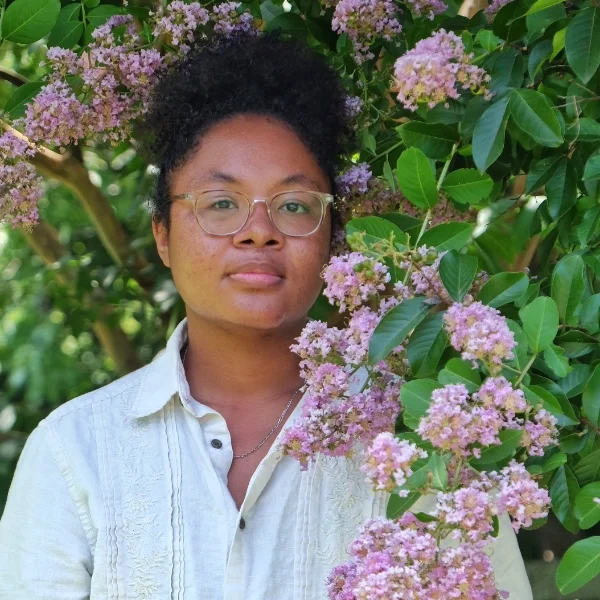
Bitter Kalli is a writer and landworker born and raised in Brooklyn, NY. They work across mediums including soil, seeds, and printed matter. Bitter is the founder of Star Apple Nursery, a project focused on increasing access to African and Asian diaspora heritage crops. They are also the author of the essay collection Mounted: On Horses, Blackness, and Liberation. Bitter is based in Philadelphia.
Storytelling that challenges America’s colonial roots
Peace & Riot brings you stories from the frontlines.
From the activists who pioneered the modern environmental justice movement, to the Indigenous organizers defending their sacred lands, to the agricultural laborers fighting for dignity—we’re a home for the people and movements that have always pushed this country closer to its ideals.
Keep our work alive with a donation of any size.