
SPRING 2026
Policing the Planet
How ICE and AI-powered surveillance threaten people and movements everywhere.
Julia Luz Betancourt

NYC, 2016. Arielle Bobb-Willis. This issue’s photographs were chosen for their artistry, human perspective, and emotional depth. While AI can try to mimic and steal their appearance, it cannot replicate lived experience, intuition, or the human truths that make them meaningful. Learn more about this issue’s featured photographer here.
In a December 2025 story, 23-year-old Jesus Gutiérrez told Reveal he was walking home from a gym in Chicago when Immigration and Customs Enforcement (ICE) agents handcuffed him, placed him in the back of an unmarked, gray Cadillac SUV, and scanned his face with a smartphone.
Gutiérrez, who is a United States citizen and did not have an ID on him at the time, is one of many who have been caught in the federal government’s expanding surveillance web as immigration agencies increasingly turn to artificial intelligence (AI) technology to target, detain, and deport immigrants as quickly as possible.
Since 2023, ICE and Customs and Border Protection (CBP) have spent at least $515 million on AI programs such as facial recognition, biometrics, and cloud storage from Microsoft, Amazon, Google, Clearview AI, and Palantir. They’ve used AI to locate areas to conduct raids, sift through tips sent to tip lines, and aggregate swarths of federal, state, and third-party data to more accurately track people’s identities and movements.
“The biggest effect of AI in surveillance is that it allows for surveillance to be scaled up and automated,” said Jay Stanley, a senior policy analyst at the American Civil Liberties Union (ACLU). “You don’t have to be that prominent anymore to be under the eye of Sauron. You can come to the government’s attention en masse.”

ICE off Stolen Land. © Humanizing Through Story, Jon Stegenga.
But the government’s rapid adoption of AI also has an environmental cost
After returning to the Oval Office, President Donald Trump signed several executive orders to accelerate AI and data center development in the U.S. The push has emboldened Big Tech companies to race to advance their variations of AI and cloud storage, including for immigration enforcement.
A 2025 report by MediaJustice revealed that tech giants Microsoft, Google, Amazon, and Meta spent at least $100 billion on data center construction in the summer of 2025 alone.
“For AI technologies that rely on data centers, the facilities themselves require power sources like gas, coal, and nuclear energy,” the report reads. “This is further pushing for the construction of new gas pipelines and nuclear reactors across the South, two things that also endanger Native territories.”
At least 60 proposed or constructed hyperscale data centers exist on or near Native territories across Turtle Island, according to a Data Center Tracker built by Honor the Earth, an Indigenous-led organization fighting to dismantle settler-colonialism, racial capitalism, white supremacy, and imperialism.
As data centers boomed in 2025, the organization launched the No Data Centers On Native Land campaign to highlight the relationship between AI facilities and the mining of Native lands, which it describes as a new form of “data colonialism.”
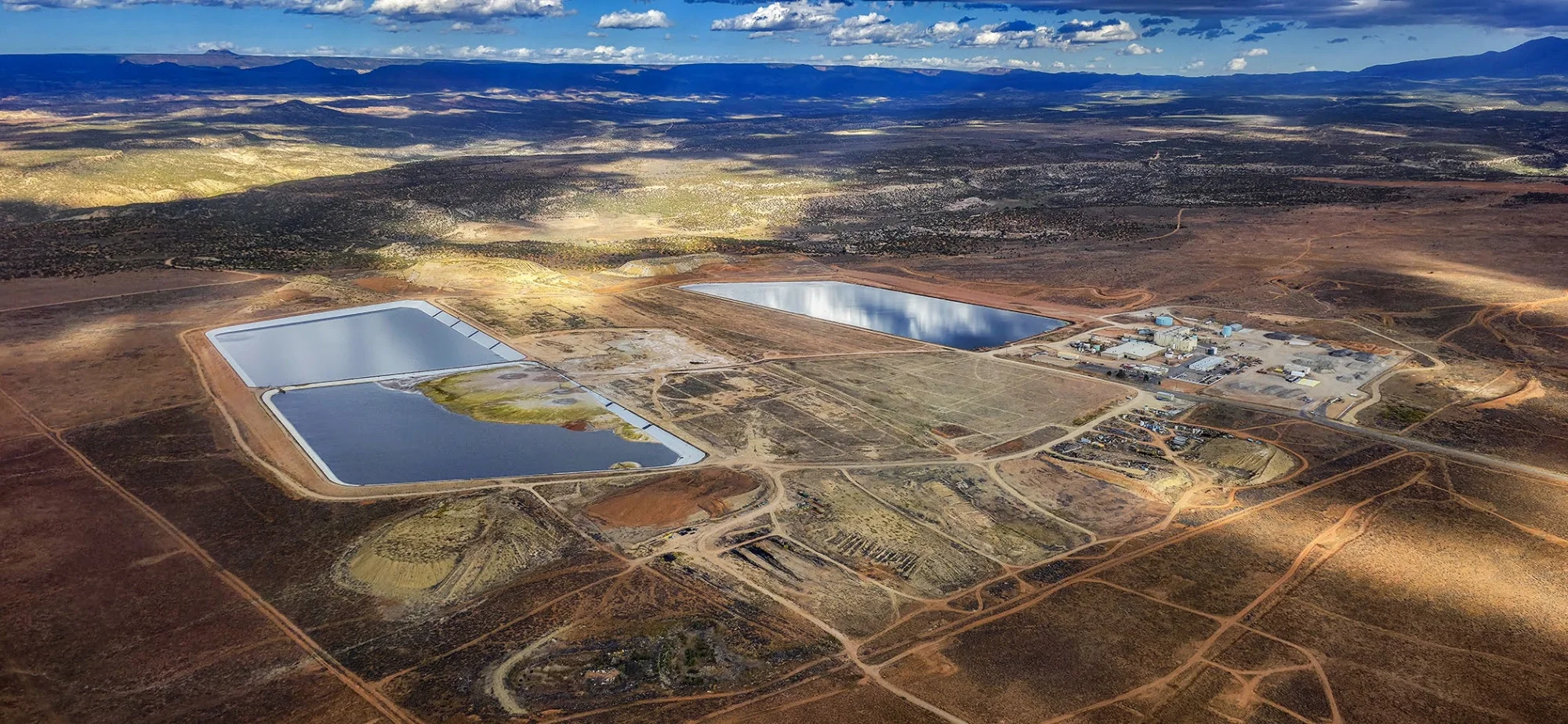
White Mesa Uranium Mill, 2025. (c) Tim Peterson, flown by EcoFlight.
“Our initial focus was extraction of critical minerals,” said Ana Rivera, Honor the Earth’s IT Director, of the Rarámuri Tribe. “As we followed the demand for this, that demand led us to data centers. What are data centers actually used for? AI.”
To illustrate this, Honor the Earth created a toolkit of fact sheets and presentations that equip Indigenous communities with the information needed to defend their lands against AI and data centers. One fact sheet, “The Death Cycle of AI,” shows how minerals like lithium, cobalt, and uranium found on Indigenous lands are mined before they are used for data facilities, which power cloud storage and AI that is then used by police, ICE, border patrol, and other enforcement agencies.

“The AI-Nuclear Connection,” another fact sheet, explains how data centers drive up demand for nuclear energy projects.
“An estimated 70% of the world’s uranium deposits are located on or near Native lands. As a result, radioactive materials are transported through Indigenous territories, exposing people who live on them to industry development, contaminated water, abandoned mines, and illness.”
An estimated 70% of the world’s uranium deposits are located on or near Native lands. As a result, radioactive materials are transported through Indigenous territories, exposing people who live on them to industry development, contaminated water, abandoned mines, and illness. More than 500 abandoned uranium mines sit on or near the Navajo Nation, alone. And in the Southwestern U.S., where uranium was sought to build nuclear weapons during the Cold War, Indigenous communities continue to suffer higher mortality rates from radiation exposure.
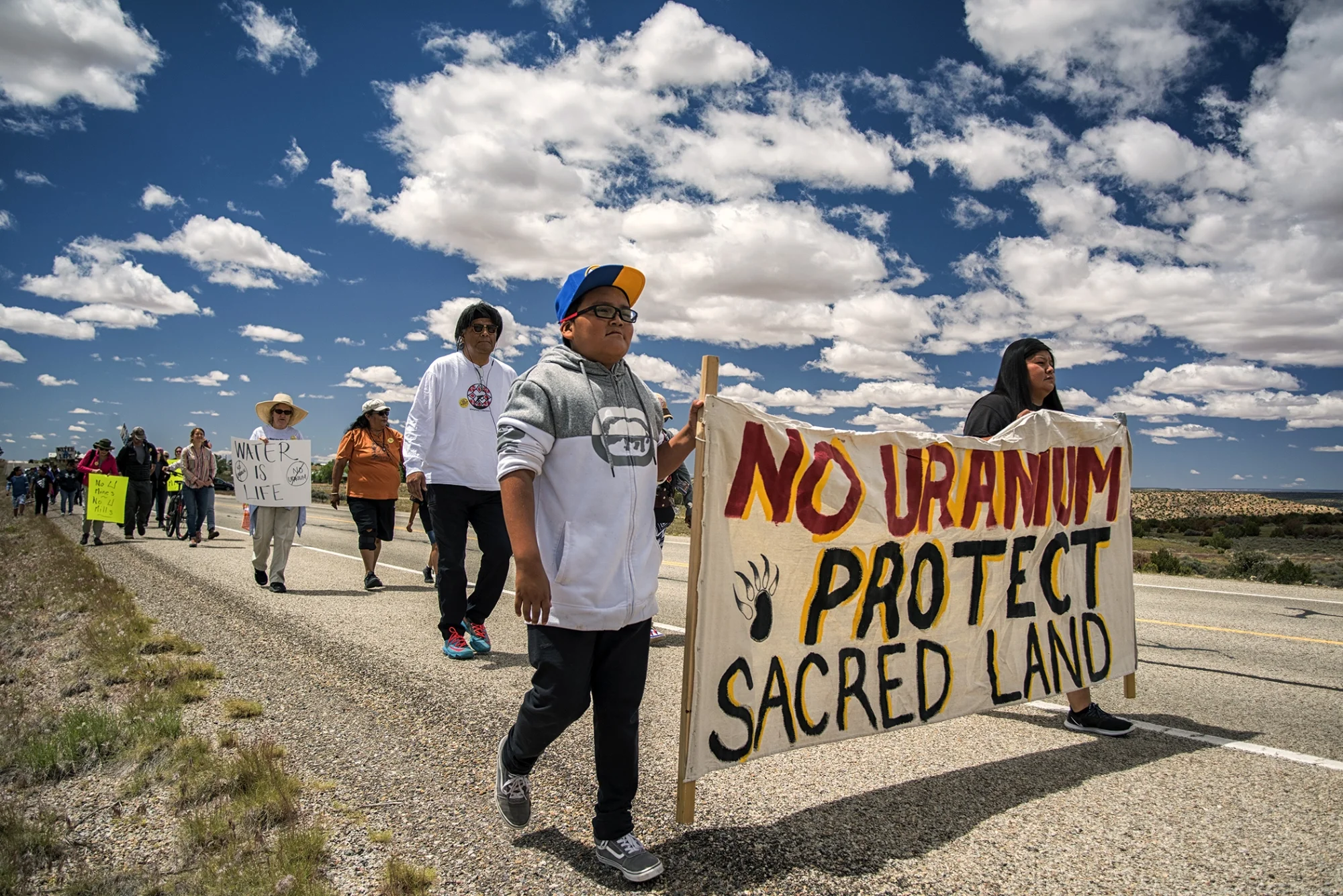
2019 White Mesa Concerned Community Spiritual Walk and Protest, (c) Tim Peterson.
“We are killing the earth, and in return, we are killing ourselves,” said Lala, social media manager at Honor the Earth, of the Nahua and Mextico Tribes, who asked to be identified by first name only.
“We are killing the earth, and in return, we are killing ourselves...”
For Lala, the extraction of Native ecosystems and harm faced by Indigenous communities in the U.S. is part of a larger pattern of how colonial empires are using AI around the world to colonize lands, including Israel’s genocide in Palestine.
In 2024, an investigation by +972 Magazine and Local Call detailed how Israel used AI softwares known as “Lavender” and “Where’s Daddy?” to mark Palestinians to assassinate, then track their whereabouts. As many as 37,000 Palestinians were identified through the technology, which marked their homes and villages for possible air strikes.
“We are extracting so many minerals, waters, and dropping bombs all at the same time, and all of that is interconnected,” she said. “All of these attacks and bombs that we are constantly dropping in Falastin (Palestine) with AI software is all included in the impact on Mother Earth.”
“This is the first digitized war that we’re seeing. And when I say digitized, I mean because of the reliance on artificial intelligence,” Rivera added. “That’s the greatest example of what happens when these things are permeated through society and then used as a tool of repression.”
As the government’s AI capabilities expand, immigrants are not the only ones susceptible to more invasive surveillance. Heightened surveillance comes at the price of everyone’s privacy, Stanley said, which could result in further crackdown of environmental movements.
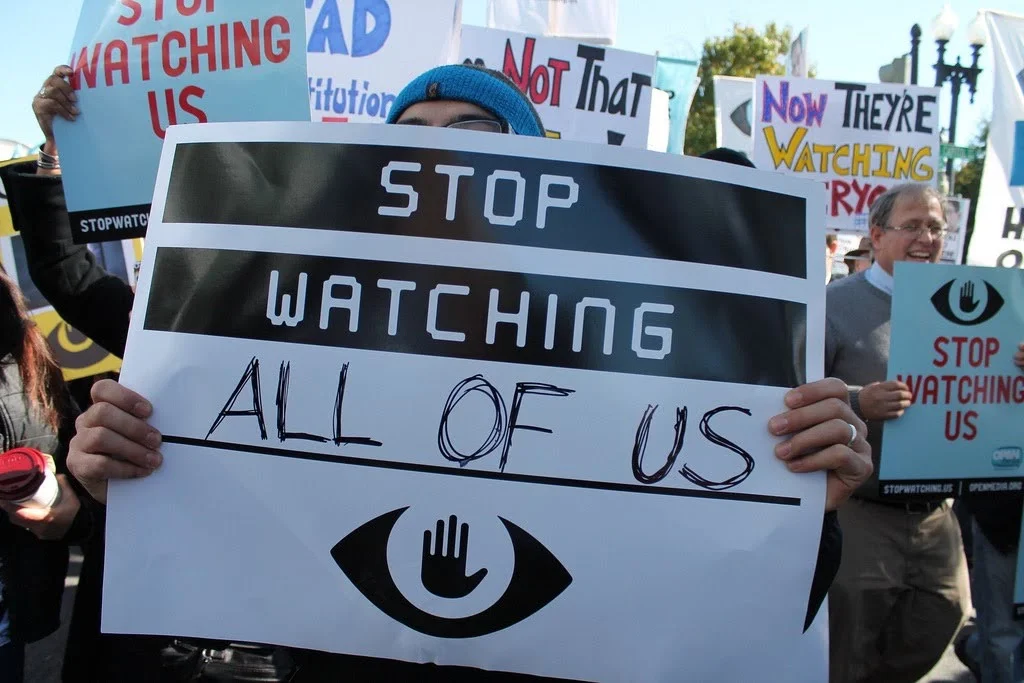
A march against mass surveillance in Washington D.C. Photo by Elvert Barnes
AI consolidates “a huge amount of power to government agencies that have consistently, for the past 100 years, misused their power to go after people not because they’re suspected of a crime, but because of their political views that the powers that be don’t like,” he said. “Big companies have historically been generally A-okay with authoritarianism.”
Environmental activists, including Indigenous leaders, continue to endure intrusive surveillance for protesting against polluters.
In 2025, ProPublica revealed that law enforcement agencies collaborated with private security companies to surveil Indigenous activists organizing against a lithium mine in Nevada. During the Dakota Access Pipeline protests in 2016, a security company backed by the oil and gas industry used military-style counterterrorism tactics to monitor water protectors — and collaborated with law enforcement from five states to do so.
Now that the Trump administration is blatantly targeting immigrants en masse, this same trend is occurring within DHS. ICE and CBP have used AI to surveil citizens through facial recognition, biometric scanning, and social media monitoring. In the uproar against immigration agents occupying Minneapolis earlier this year, federal officers collected personal information on protesters, including Alex Pretti, who was shot and killed by a CBP agent while acting as a legal observer.

Minnesota’s Indigenous community held a jingle dress ceremony at the memorial sites for both Alex Pretti and Renée Good, honoring their lives. © Humanizing Through Story, Jon Stegenga.
“They’re using lots of different data sources, combining these data sources from different parts of the government and outside of the government — even local resources — and AI is helping to combine these data sources into one,” said Steven Hubbard, a senior data scientist at the American Immigration Council. “The result is a much more complete and detailed profile of a person’s life, movements, and relationships.”
A merged data set, Hubbard said, can create several risks: the increased likelihood of errors in data; the ease with which federal agencies can act on computer-generated profiles or risk scores instead of direct evidence; and less transparency and accountability around how data is being used, analyzed, accessed, and overseen.
And this has already had real consequences. Throughout his second term, Trump has signed executive orders aiming to consolidate government data across agencies, including one signed in March 2025 that called for the dissolution of “data silos.” The following month, ICE and the Internal Revenue Service (IRS) signed an agreement allowing immigration agents access to personal information held by the IRS, such as the names and addresses of taxpayers.
“It’s a different kind of system altogether, one that can enable more pervasive and less accountable forms of surveillance. This data is not just about immigrants. It’s all of us.”
“It’s a different kind of system altogether, one that can enable more pervasive and less accountable forms of surveillance,” Hubbard said. “This data is not just about immigrants. It’s all of us.”

Workers against ICE protest. © Humanizing Through Story, Jon Stegenga.
An overwhelming number of those who have been detained under Trump 2.0 have no criminal record. Citizens and immigrants alike have spoken out about an increase in racial profiling and attacks on free speech, especially against those who have spoken out against Israel’s genocide in Palestine.
Dozens of Native Americans have been questioned or detained by immigration agents since January 2025. And in border communities like Tucson, Arizona, residents are grappling with a surge in immigration enforcement while a recently approved hyperscale data center deal known as Project Blue threatens their local environment.
“We live in a desert. We have a very finite water supply,” said Anissa, a citizen of the Pascua Yaqui Tribe and an organizer with the No Desert Data Center Coalition (NDDCC), which works to mobilize communities in Tucson against Project Blue. “And with climate change, obviously things aren’t getting better.
Project Blue, one of the largest development projects in the region’s history, was kept hidden from the public for at least two years under non-disclosure agreements (NDAs), which have been used in other data center projects to keep communities in the dark.
Planning discussions for Project Blue began at least as early as 2023, according to email records between Pima County officials and a real estate investment firm known as Diamond Ventures. But it wasn’t until April 2025 that Pima County held a hearing about its plans to rezone areas of Tucson acquired for the data center — which it would use to access Tucson’s potable water.
Later that July, Arizona Luminaria unveiled that the company behind the data center was Amazon Web Services (AWS) — one of the companies providing cloud storage to ICE. And in September 2025, AWS received a $25 million purchase from ICE. Since the start of Trump’s second term, the agency has spent more money on Amazon and Microsoft cloud products than ever before.
“Data centers require resource extraction upstream in the form of mining for minerals that go into chip manufacturing, they require energy generation (which also takes large amounts of water, is tied to the fossil fuels industry, and has a legacy of contamination and health impacts on Tribal Nations), and they require huge parcels of land to be constructed on,” said Anissa, who asked to be identified by first name only. “All this for the development of something that is in service to empire.”
To grow opposition against Project Blue, the NDDCC hosted community information sessions and organized residents to call Tucson City Council members’ offices, write letters, and reach them on social media.
“We already deal with border patrol and ICE terrorizing people here in southern Arizona,” Anissa said. “When more information came out about this data center wanting to use potable water to cool their system, it really got people to pay more attention.”
In response to community action, the city council voted unanimously on Aug. 6, 2025, against annexing Tucson land, which would have provided Project Blue with the water it needed for the data center’s water-cooling system.
“That was a brief moment of celebration for the coalition, but that wasn’t enough to send this project away,” Anissa said. “The next beast that we’ve had to deal with is this aspect of private utility companies.”
On Aug. 25, 2025, Beale Infrastructure — the developer involved in Project Blue — filed an Energy Service Agreement (ESA) with Tucson Electric Power (TEP), a private utility company. A deal with TEP would allow the data center to run on an air-cooling system instead of a water-cooling system.
In December 2025, the ESA was approved by the Arizona Corporation Commission despite overwhelming objections from Tucson residents. But consistent organizing from the NDDCC has brought the fight against Project Blue to the courts.
On January 14, 2026, the Arizona Center for Law in the Public Interest filed a lawsuit against Pima County officials on behalf of the coalition, arguing that the county approved the rezoning “without providing the public with accurate or meaningful notice.”
While the case unfolds, Anissa says the NDDCC continues to work on a grassroots level to bring more people into the fight against extractive industry by laying out the connections between data centers, environmental degradation, surveillance, and larger polluters like the military.
“There’s the environmental aspect; this worker aspect of being replaced by AI; this aspect of surveillance becoming intensified; or how AI is now being used for war. Drawing those connections for people and being really explicit about that, I think, is the way to win more people over and start scratching away the layers that keep people from seeing what is truly at the root of all this.”
“There’s the environmental aspect; this worker aspect of being replaced by AI; this aspect of surveillance becoming intensified; or how AI is now being used for war,” she said. “Drawing those connections for people and being really explicit about that, I think, is the way to win more people over and start scratching away the layers that keep people from seeing what is truly at the root of all this.”
And so far, grassroots efforts to push back against big tech and state surveillance has done just that.
In November 2025, the Muscogee Nation struck down a proposal that would have rezoned land into a technology park for a hyperscale AI data center. The decision came after the community organized a series of town halls across Muskogee County, informing people at colleges, community centers, and a butterfly farm about the impact it would have on their land.
In February of this year, the Cherokee Nation established a task force that will study the impacts of data centers on Cherokee lands. And on March 7, the Seminole Nation of Oklahoma, which received data and fact sheets from Honor the Earth, passed a resolution to implement a moratorium against generative AI and hyperscale data center development on Tribal lands and territories.
“We’re not just fighting for the present. We’re fighting for the next seven generations to make sure that they can drink the water, that they can see butterflies that are being impacted from all of these sound waves that come out from these massive, hyperscale data centers”
“We’re not just fighting for the present. We’re fighting for the next seven generations to make sure that they can drink the water, that they can see butterflies that are being impacted from all of these sound waves that come out from these massive, hyperscale data centers,” Rivera said.
“They should have the right to experience the Earth that we know today.”

Julia Luz Betancourt is Counterstream’s assistant editor and an investigative reporter covering how communities organize against abuses of power. Her stories have exposed university collaborations with immigration enforcement agencies, uncovered instances of political repression of pro-Palestine student activists, and revealed a surveillance technology company’s financial ties to the Trump administration. Her work can be found in BreakThrough News, Prism, YES! Magazine, Truthout and more.
Peace & Riot is made by real people — not AI.
Journalists, photographers, editors, and contributors doing original reporting from the frontlines.
That work is under threat. Newsrooms are shrinking. AI is training itself on what journalists have already built, and replacing it with something hollow.
Independent, human storytelling is being squeezed from every direction. If you value work built on lived experience, not stolen data — help keep it alive.
Donate to power more issues like this one.