
SPRING 2026
The Data Center Down the Street, and the Activist Next Door
In Maryland, organizing against dirty data centers is an act of community power
E.N. West in conversation with Vernice Miller-Travis
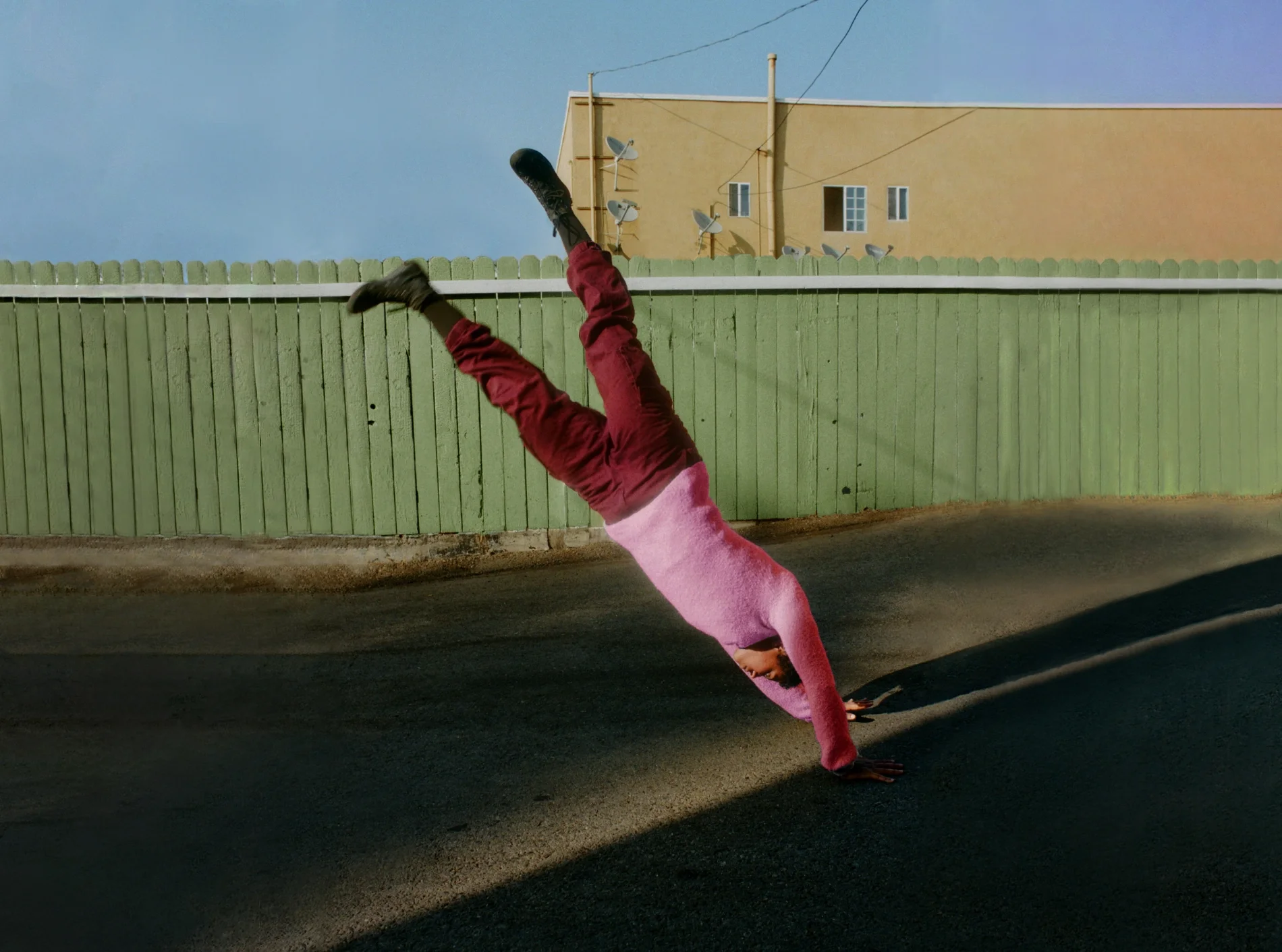
Los Angeles, 2020. Arielle Bobb-Willis. This issue’s photographs were chosen for their artistry, human perspective, and emotional depth. While AI can try to mimic and steal their appearance, it cannot replicate lived experience, intuition, or the human truths that make them meaningful. Learn more about this issue’s featured photographer here.
Talking to Vernice Miller-Travis feels like breathing air under the same sky. The day we virtually met for our interview, we learned we share not only a passion for environmental justice, but also a deep love for the Mid-Atlantic, specifically the D.C. metropolitan area. There is an intimacy to meeting someone who has been molded and shaped by the same soil, shares similar reference points, and has had to bend to familiar winds of change. This shared love of place grounds the conversation.
Vernice’s life is a love story to place. From Harlem, New York to Nassau, Bahamas to Prince George’s County, Maryland, she’s been on the forefront of building an environmental justice movement rooted in love of the land and its people. That legacy continues in her fight, alongside her neighbors in Southern Maryland, against a new data center development in Landover, Maryland.
This conversation with Vernice asks central questions that may guide others in similar battles across the country. What is/isn’t a false solution? Which narratives are effective in galvanizing local support against data center construction? What other economic and political forces influence decision-making for everyday people, and how can we, as environmentalists, speak clearly to those intersecting issues?
I offer it to the Counterstream community, with hopes it galvanizes your spirit and reminds you who and what you’re fighting for.
This interview has been edited and condensed for clarity.
E.N. WEST: One of the questions I always like to ground conversations in is around cultural geography. This can include the land, the people, and the places that have formed you. How would you describe your cultural geography?
VERNICE MILLER-TRAVIS: Well, I start in Harlem, New York, where I was born and raised in the 1960s. Everything was popping in our country, but it was particularly popping in our community. And it's because we had some leadership there who were deeply ensconced in the movement for civil rights and liberation. That included the dynamic, extraordinary Reverend Adam Clayton Powell who was both a member of Congress and the senior pastor at a very activist church, the Abyssinian Baptist Church. Malcolm X was also live and in charge, and Harlem was his base. His Mosque No. 7 was in Harlem.
Harlem was a mecca for Black people in the diaspora. So no matter where you were from on the face of the earth, if you were Black and you were coming to the United States, one of the first places you would come to was Harlem. Both of my parents—my dad was from the Bahamas and my mom was from Baltimore—were part of that migration.
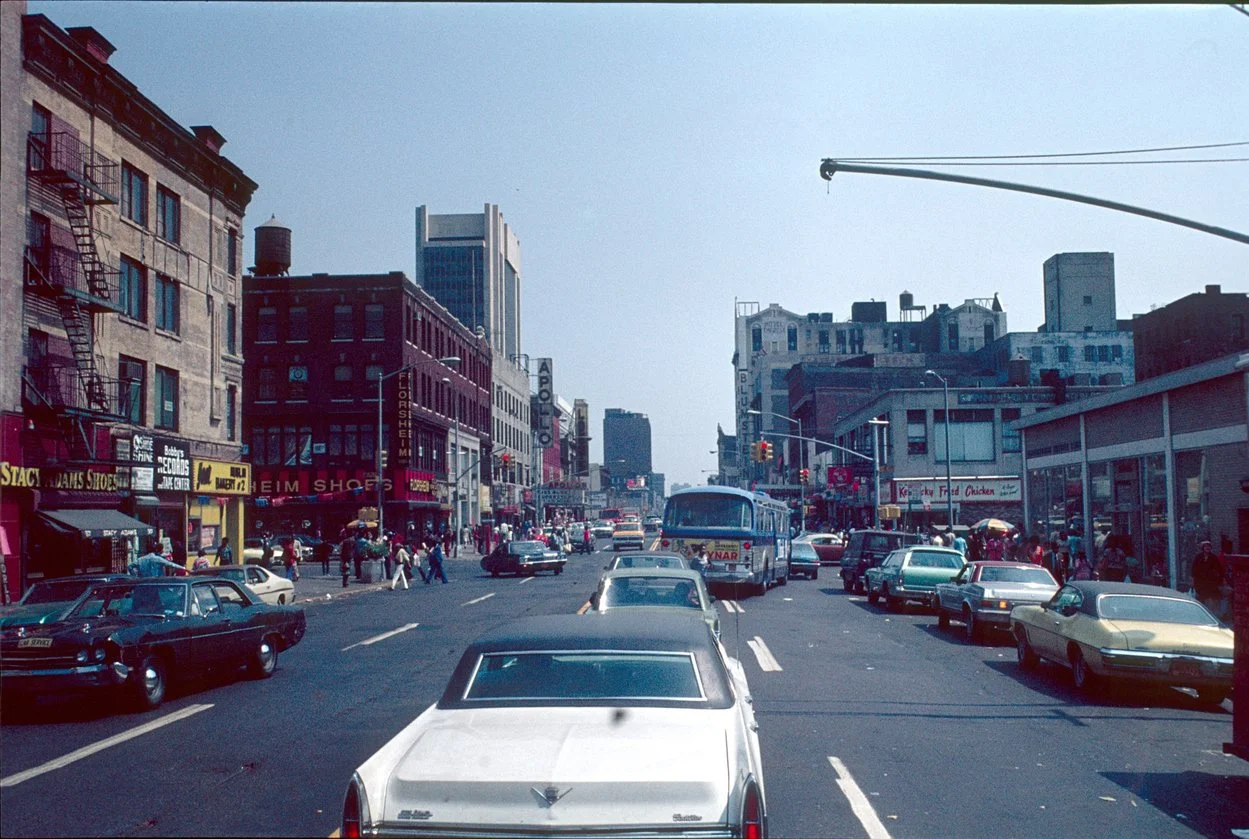
New York, NY. April 28, 1976. District of Harlem. Lively street scene at the intersection of Dr. Martin Luther King Jr. Blvd. and Frederick Douglass Blvd.
VERNICE MILLER-TRAVIS: My mother was a pediatric nurse at Harlem Hospital, where I was born. My dad supervised the part of the hospital where you go to get clinic appointments or doctor's visits. Everybody knew everybody's family. We socialized together and it was a village. I experienced a faith community, a political community, a cultural community. My dad was a member of District Council 37 of AFSCME, and that union was part of the bulwark of the labor movement support for the civil rights movement.
My elementary school was led by the first Black woman to be a principal in New York City. Our school was the Matthew Henson Public School 100. And our principal was Adele W. Timpson. Ms. Timpson held the educational theory that Black children were capable of learning anything, that we had no deficits in our intellectual abilities—even though that was the dominant paradigm at the time. So she exposed us to some of everything and anything. As kindergarten students, we even had the experience of learning from Faith Ringgold. She was a famous Black artist but also a New York City public school teacher. She was very active in the Black arts movement while she was our art teacher.
And the thing I would say to you, E, is that I was loved on by everyone who came in contact with me. My mother and father's colleagues at the hospital, my teachers, my principal. I had a wonderful babysitter who was from Barbados. I was surrounded by that Caribbean culture.
“So when you think about it, at the end of the day, there was no lane for me to go into but a lane around social justice. And if I could live my life again, I would want it to start right there. In that place.”
My family was part of a Catholic church, St. Mark the Apostle, in the middle of Central Harlem, although our priests and nuns were mostly white. At that moment, the Catholic Church, at least the Catholic Church in New York, was completely engaged in the civil rights movement in that they were trying to teach us the social gospel. You know: the word of God and the edicts that Jesus left for us are about liberation, right? So when you think about it, at the end of the day, there was no lane for me to go into but a lane around social justice. And if I could live my life again, I would want it to start right there. In that place.
E.N. WEST: You start to speak to this a little bit, but some of the threads throughout your life—from the hospital to the role of the labor unions in the neighborhood to the era of the social gospel that you're speaking about, you almost had no choice but to care about the world, to participate in social justice, like you said. What brought you to environmental and racial justice in particular?
VERNICE MILLER-TRAVIS: So my parents separated when I was in kindergarten, actually. My mom moved out, and my dad and I stayed put because she didn't want me to be separated from my school. She must have recognized that there was something special about that school! Then when I graduated from elementary school, I went to live with my mother. We lived in Jamaica, Queens, for a minute, and then we moved to the Bronx, to the West Bronx, walking distance from Yankee Stadium.
The neighborhood was called the Highbridge section of the Bronx. But for some reason, the middle school for that neighborhood was in the South Bronx, and the South Bronx was a bus ride away. And it was night and day different between those neighborhoods. There was an active effort by white property owners to displace the Black and Latino communities who rented from them. They figured out that, because these people were so poor and working-class, if you actually burned the buildings down, and collected the insurance, you would recoup more financially than the monthly rent rolls. This may sound absolutely unreal, but there was a whole period of time (early to mid-1970s) when they were literally burning the South Bronx down to the ground, and simultaneously closing down fire stations as part of a New York City policy strategy known as ‘benign neglect.’
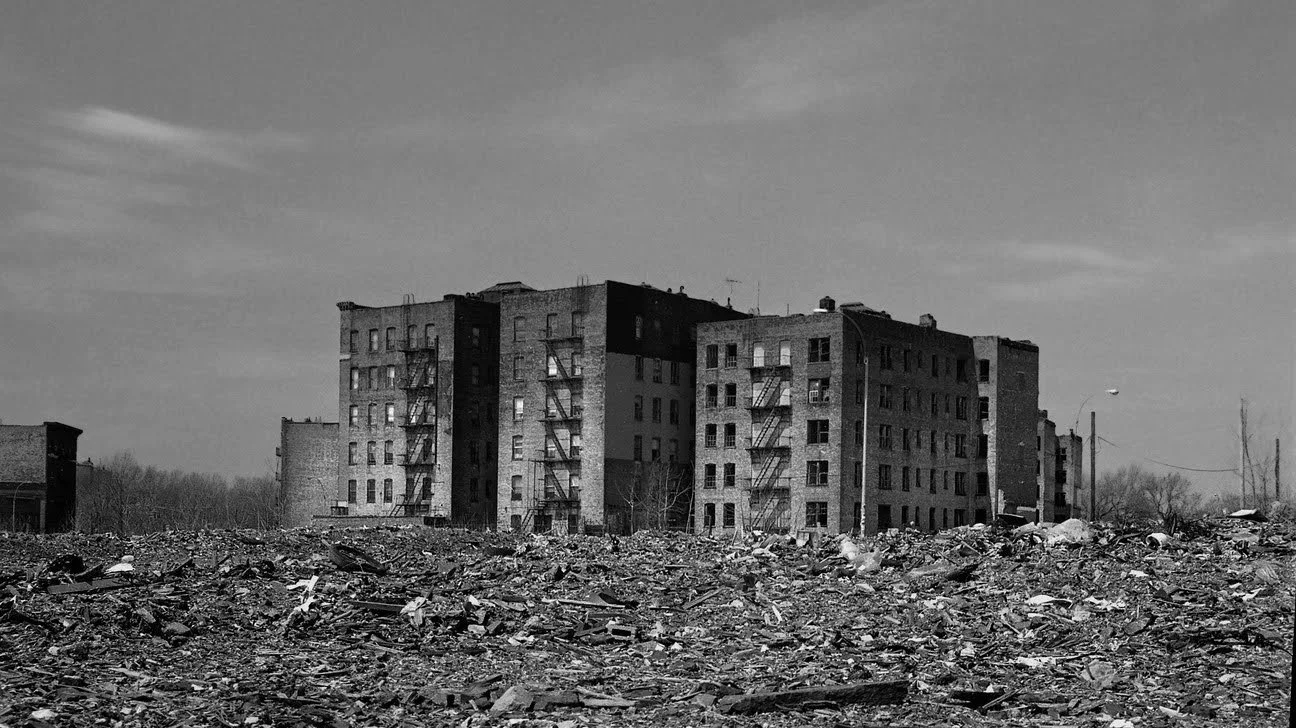
A building surrounded by rubble in the South Bronx during the 1970s, an era of disinvestment—when landlord abandonment, arson, redlining, and the construction of the Cross Bronx Expressway displaced residents and accelerated neighborhood decline.
VERNICE MILLER-TRAVIS: But the thing about the South Bronx that really affected me, in a deep way, was the first day of school. We go to the “playground” for lunch or recess and there are no play things. Just asphalt and a chain link fence. And I swear to you, two street gangs are outside having a gang war in our playground on my first day of school. And I'm like, oh, dear God. What the hell is gonna happen to me? This is not the place for me. But apparently it was the place for me, because we had a phenomenal award-winning music program, with an orchestra, a band, and a chorus, and that's when I discovered gospel music, from my Jewish middle school chorus teacher. To this day, it is one of the things that I turn to for solace, for comfort, for clarity.
While attending CJHS 145, I also started to participate in an accelerated program called A Better Chance. So we went to school on Saturday, but the school we went to, E, was way up in the Bronx, in a community called Riverdale, which was near one of the most affluent communities in the United States, Scarsdale, NY.
“You see trees, grassy lawns, big, beautiful houses, and you see the hue of the people who live in these particular landscapes change. When I came back home, there would be broken sidewalks, the garbage may or may not be picked up, back in the Highbridge community, and in the South Bronx, they’re still burning it down.”
And the reason that I'm an urban planner, I think, is because when I would travel from the West Bronx, where we lived, up to Riverdale, all in the same county mind you, as you're taking a bus, then a subway, you see the landscape change. You see trees, grassy lawns, big, beautiful houses, and you see the hue of the people who live in these particular landscapes change. When I came back home, there would be broken sidewalks, the garbage may or may not be picked up, back in the Highbridge community, and in the South Bronx, they're still burning it down. I would receive a scholarship to attend an elite private high school called the Ethical Culture Fieldston School in Riverdale. But this juxtaposition of landscapes was something I experienced every day for four years. You couldn’t help but notice that the things happening in the place where I lived are not going on where the white folks lived in Riverdale. And I really began to pay attention to these differences, and it became a driving force for me in the environmental justice work that I do to this day.
E.N. WEST: It's interesting to hear the role that education and educational institutions played in your cultivation, in who you are and your investment in environmental justice.
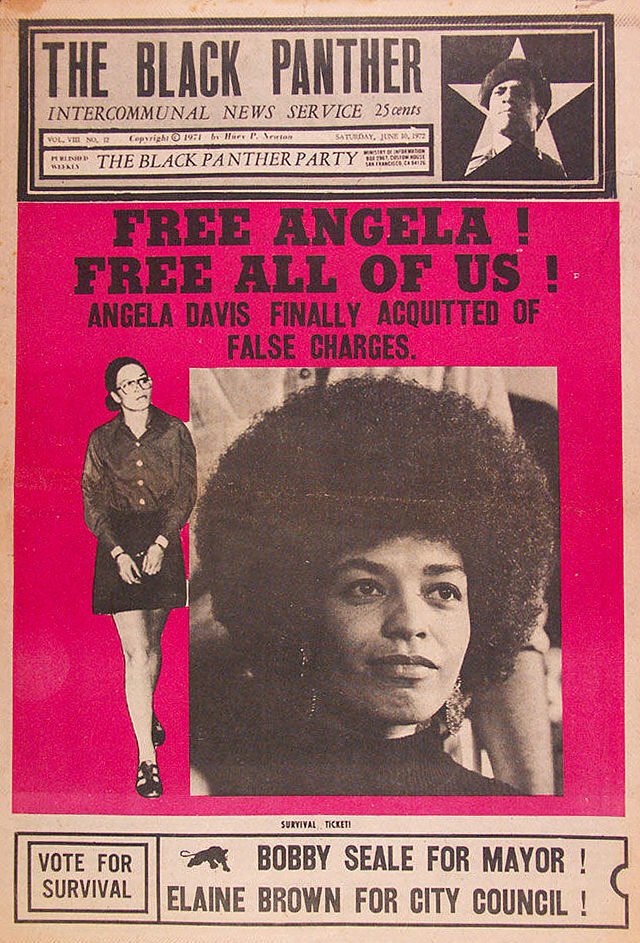
The Black Panther (also called The Black Panther Intercommunal News Service) was the official newspaper of the Black Panther Party. It began as a four-page newsletter in Oakland, California, in 1967 and remained in circulation until 1980.
VERNICE MILLER-TRAVIS: And the one thing I left out is that one of the things I wanted the most in life when I was a child was to be a member of the Black Panther Party. We always had the most current edition of the Black Panther newspaper—it was always in my mother’s house. And that also is a very strong component of my growing up, because the thing that really appealed to me was Black liberation.
On the other hand, we were Black Catholics on both sides of my family, right? And during that time, I think the Black Church was more connected to liberation movements than we were. The Church was teaching children at the time, that you have a role to play in this effort, right? You have a role to play in this effort because poverty is not what God wants for his people. Inequality is not what God wants for his people. Suffering is not what God wants for his people.
So that was poured into me and growing up, the clearest expression of those values for me was the Black Panther Party and Angela Davis, which made my dad crazy! My dad was a Martin Luther King person. So we argued about that a lot, about Black Power vs. non-violent social change. But it was my Dad’s exposure and his civic work and his life that showed me that, you know, you gotta be a part of this movement. You gotta do something. You can't just sit there, right? While your people are suffering, you must do something.
E.N. WEST: Thank you so much for all of that. That was so wonderful to listen to.
You’ve set the context of where you came from and how it's brought you to where you are today. But I'm also curious about your context now. You’re in Bowie, Maryland, in the DC metropolitan area. It’s a part of the country that’s directly suffering from the impact of AI-driven data centers.
What have been some of the impacts of these data centers on the community? And what resistance efforts have you witnessed or participated in related to blocking or ameliorating the harms from the pollution caused by these data centers?
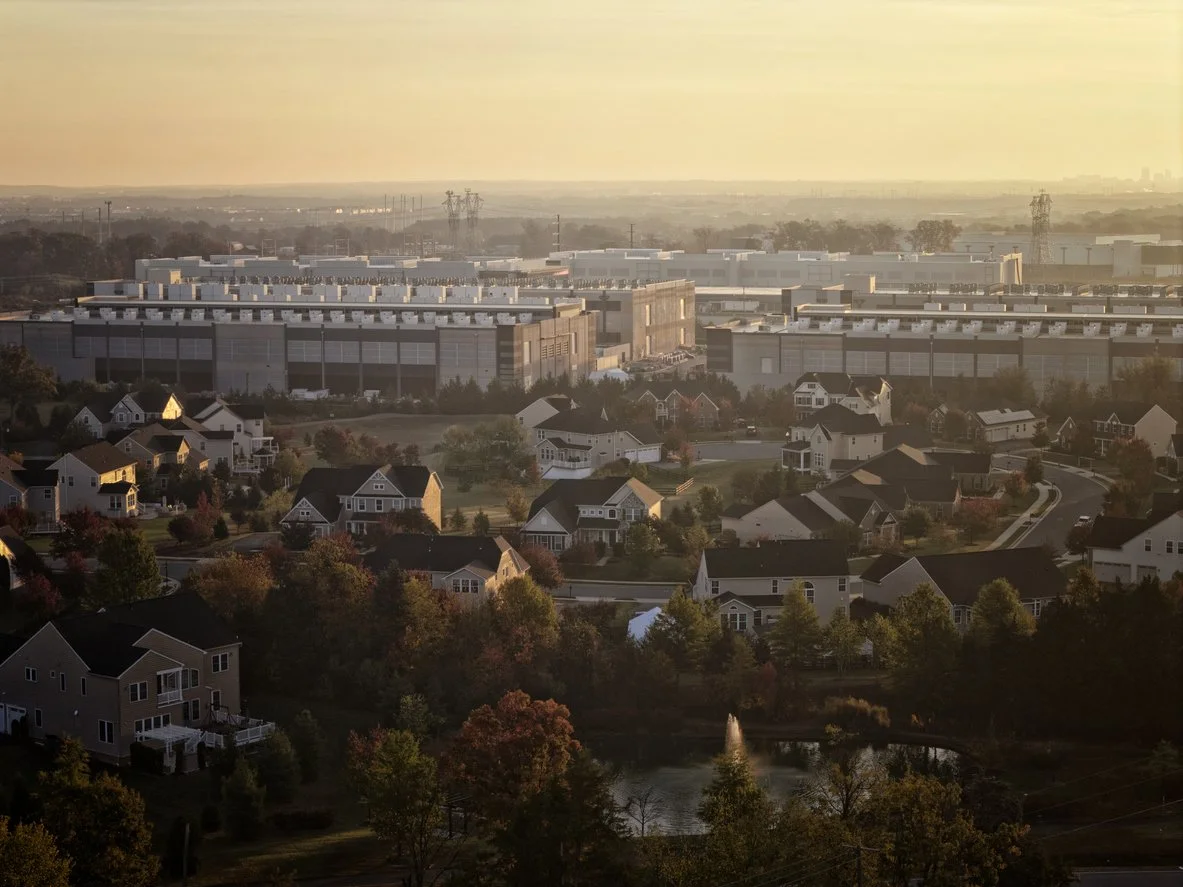
An Amazon Web Services data center looms over a residential neighborhood in Northern Virginia. Northern Virginia has the largest concentration of data centers in the world, often called “Data Center Alley.”
VERNICE MILLER-TRAVIS: You, E, are from across the bridge in Alexandria. And Northern Virginia is the AI data center capital of the world. In Ashburn, Virginia alone, they have 154 data centers, and they're enormous. I really don't know how there could be any people still living over there. There's so much data center infrastructure. So with that, as our immediate example, it's taken over our region.
There's a battle going on in Prince George’s County right now in Landover, Maryland to keep a data center from being sited there, and the site is the old Landover Mall. E, you’re from here, and I've lived here for 28 years. I moved here to be with my late husband. I never thought I would live anywhere else but Harlem. But Rudy Giuliani had become mayor of New York during the height of the crack cocaine epidemic, and the police were not distinguishing between drug dealers and everyday working people. They were really coming for us, particularly in my community in West Harlem, in Sugar Hill.
When we started looking around here, E, there were Black farm owners, Black homeowners, Black business owners. I love it so, right? I love everything about this place, except that for some reason, people in our local government have an aversion to grass and trees. And so they are saying yes to every developer that wants to develop something. The development that has happened over these 28 years has been mind boggling, and now the data centers are coming for us.
A nearby Six Flags amusement park closed in November 2025. Now the 600-acre site with protected forests all around it is vacant, and the idea has been floated that maybe it could be a data center. When I tell you, hell no, please believe me.
“We think of data centers as a localized issue, specific to a particular community, but their impact is everywhere—which means the responsibility to challenge their construction is on all of us, too.”
We’re all involved—even though Landover is, I don't know, maybe 20 miles from where I live— we're all involved in this fight to keep our county from turning into what Northern Virginia has turned into. We think of data centers as a localized issue, specific to a particular community, but their impact is everywhere—which means the responsibility to challenge their construction is on all of us, too.
The NAACP's Center for Environmental and Climate Justice, along with the Center for Engagement, Environmental Justice and Health INpowering Communities, just published a report earlier this year on data centers, for which I wrote the foreword, called The People's Report - Data Centers in Prince George's County, MD. And the reason that they put that report out is because our county council, which is mostly Black folks, were trying to pull a fast one. We're about to sign off on a data center coming to that former Landover mall site, and people got wind of it. They built a coalition, they've been throwing down, so much so that they stopped the county council from going ahead and permitting the site, and now they have a subcommittee, a data center task force, that's looking at the feasibility of that site. And so the question is, what does that mean for our county and its future?

Hundreds of Prince George’s County residents rallied against the proposed data center in Landover, MD on Sept 11, 2025. Photo courtesy of Party for Socialism and Liberation - DC.
VERNICE MILLER-TRAVIS: You are from here, E, I am not. But my passion for this place is so deep. All of that is to say, we ain't trying to become Northern Virginia. We’re not feeling that at all. We are in this difficult moment where they're closing federal agencies. 14 federal agencies are headquartered here in Prince George’s County. The USDA agricultural campus, the NASA Goddard Space Flight Center. Almost a million people live here. Overwhelmingly people of color. Overwhelmingly middle class, highly educated people of color, doing well. I'm telling you all of that so you get a sense of how dynamic this place is. There is not, to my knowledge, another place, quite like Prince George's County, Maryland, in the country. But they are coming for us.
This is all going on in the context of this data center fight. So our county—and I just have to be straight up about this—is trying to figure out, how are we gonna fill the economic gaps that are being left in the wake of mass federal firings?
So, we are trying to help both our county and our county leadership understand that, though we are in difficult economic straits at this moment, this too shall pass. If you bring data centers here, it's going to really impact the quality of life for those of us who live here.
“One thing that we are experiencing is an explosive growth in the cost of electricity.”
One thing that we are experiencing is an explosive growth in the cost of electricity. On our neighborhood Nextdoor app, the only thing people are talking about is the cost of electricity. In fact, it is such an overwhelming issue, I finally went and got solar panels installed on my home, because I was watching this conversation about people's electricity bills tripling.
I'm an environmentalist. I'm tracking the Inflation Reduction Act and its impact on solar tax credits, but the average person is not doing that, right? This is what I do for a living. So what happens if you live in a household where both parents were federal employees and both of you lost your jobs, and you're not at retirement age? That was the case for thousands of households here.
So, when you look at the potential entry of data centers into a climate like this—I want to say that I recognize that our local government leaders and our county government leaders are in a very difficult position. But even in that context, we want to make sure that people don't make bad decisions. It’s a bad decision from a land management standpoint, right? It’s a bad decision from how much energy it takes to run a data center. It's like a sci-fi movie! It requires an enormous amount of fresh water to cool the processors. And I keep asking a question, why must they use fresh water? Why are they drawing from the same drinking water supply that we are dependent on? And if we get to a moment where our drinking water supply is really limited, who gets priority? Is it the data centers? Or is it the residents?
What we don't want to be is rolled over like a Mack truck by decisions that others make, in this difficult political moment, because of economic conditions that I don't believe are gonna last forever, right? Our decision making has to be conscientious, it has to be environmentally and sustainably grounded, and it has to be in line with what the people need. And what we need is an expansion of our electric grid that's fed by green energy.
We can make that decision for ourselves as Marylanders, as Prince George's County residents. Because if you let the data centers in—look at Northern Virginia. There's no going back.

Hundreds of Prince George’s County residents rallied against the proposed data center in Landover, MD on Sept 11, 2025. Photo courtesy of Party for Socialism and Liberation - DC.
E.N. WEST: I think that point about being in front of the issue is huge.
I grew up in Northern Virginia, and I was not aware until recently that this was a data center alley. Both of my parents are highly educated and deeply tapped into the community: one worked for the federal government, another one for a nonprofit. I grew up going to the United Methodist Church in Oxon Hill. And I say all that to say that this is an area I'm deeply familiar with, right? But the existence of data centers isn’t always visible, and can be kept under wraps from the public. Now we’re in a moment where there's more time to prepare, to organize and get ahead of it. And it sounds like where you are coming from, there has been a pushback.
VERNICE MILLER-TRAVIS: There's pushback, but whether or not our pushback is gonna prevail in the final decision making is yet to be determined. What we don't want to see happen is, first of all, we don't want them here in our county. Secondly, we want to look at what are some other kinds of land uses that could happen that are more sustainable, that are value adds, that bring something to our community as opposed to taking something, right?
With the rising cost of electricity, there's a lot of conversation going on here now, why don't they reopen those coal-fired power plants that they shut down in Maryland? There’s this belief that more sources for electricity would bring down cost.
“We all need electricity, but we don’t need to pay for it at the cost of our lives, our health, our respiratory health.”
If people are not environmentalists or public health folks, they might not understand why we fought that fight to shut down those coal-fired power plants in the first place, right? We all need electricity, but we don't need to pay for it at the cost of our lives, our health, our respiratory health.
So we're making progress on some fronts, and then you hit an economic wall. And when you hit an economic wall, people immediately want to jettison all the green things. Many people think that is what’s causing us to pay more for energy. But it’s the data centers that are causing us to pay more for energy at the household and ratepayer level, right? The issue is: who wants to have that conversation? Who's gonna hang in there long enough to have that conversation, to understand the real root causes? All people know is: the cost of food and electricity is going through the roof, and people are losing their jobs.
I recently returned from Memphis, and the Musk-owned Colossus 1 (aptly named) xAI data center is in Memphis. It's almost as big as the city itself. Nobody should have to live next to something like that, that produces tons of diesel exhaust pollution daily, and hums incessantly. But historically, African-American communities do. And they're fighting that fight in Memphis, but I know from my experience fighting a sewage treatment plant in West Harlem that it’s much harder to halt a thing. Once that bad boy is already under construction, the likelihood that you're gonna stop it is next to zero, right? So we have to get ahead of it, and that's where we are at in Prince George’s County.
This is the moment that requires clear thinking. Strategic thinking, and visionary thinking. Oftentimes people who are in elective offices are about day-to-day, problem solving and management, but they are not always about vision; what's the future that we want, and how are we gonna get there?
And data centers are not the future that we want.
E.N. WEST: I love what you shared, about how it’s important to have nuanced conversation, to really respond to people's everyday concerns surrounding the cost of living.
That’s why I want to spend some time discussing narrative work because I do think that’s a critical part of the conversation on data centers. Data centers have been around a long time. This is not new technology. AI has been around a long time: it’s not a new technology, either. But the way it's being talked about, whether from people who are proponents or people who are opponents or people who are somewhere in the middle, has dramatically changed.
When you consider your connections with your neighbors, have you experienced any talking points that inspire them to reconsider their positions?
VERNICE MILLER-TRAVIS: Well, one thing certainly is helping people understand the straight line between the proliferation of data centers, their enormous thirst for energy, and how that need is driving their household electricity cost through the roof.
But there's a lot more work we need to do as environmentalists, and people who care about this issue, to make that conversation more relatable for the average person, right? Because everyone is paying the price.
“The top 10%, they are making money hand over fist. The rest of us are catching hell.”
The top 10%, they are making money hand over fist. The rest of us are catching hell. You got housing costs going up, your utilities are going up, gas is going up. Everyone is feeling the economic pinch.
I do a lot of work now around strategic communications and messaging. And if you can't translate the things we work on in a way that average people understand, then you are not doing a good job. People need to know, what does this issue mean for me, for my family, and for my community?
So with the energy and data center issue, we have to figure out how to make it meaningful to people. And that doesn't mean speaking over people's heads, it means understanding where people are. You could talk, for example, about data centers and the impact on the future employability of their younger family members. If AI is going to replace so many of the things that we do, how will they be able to keep working? What entry-level jobs will be left?

Hundreds of Prince George’s County residents rallied against the proposed data center in Landover, MD on Sept 11, 2025. Photo courtesy of Party for Socialism and Liberation - DC.
VERNICE MILLER-TRAVIS: It's such a different moment than the moments that I came through. As people of color, as immigrants, as the children of immigrants—I'm a first-generation American— everything that everybody told us we needed to do is changing right? Gotta go to school. Gotta be a good student. Get a good education. Get a good government job. Take care of your family. It used to be that you got in, moved up the ladder, received a pension. But they’ve changed it up.
Let me make it personal for folks. My husband died eight and a half years ago. But he always told me that I was gonna be okay when he was gone, right? And I didn't want to hear that. I'm gonna be okay, what are you talking about? Well, this is what he was talking about. Because of his federal service, I'll have top-level medical insurance for the rest of my life. My mortgage will be paid because as his widow I receive a partial pension payment. So that’s two very important things that I don't have to worry about.
I was with a mentor having dinner recently, and he asked me how come I had a photo of my husband on my debit card. And I said, it’s because I want to look at him every time I make a transaction. Because my financial stability is based on him having looked out for me. Even from the grave, he is still taking care of me, and that's because my husband worked for the federal government for 30 years.
But that kind of financial security doesn’t exist anymore. So when we talk about the rise of data centers, we also have to talk about the dire economic conditions that are undergirding it. People are struggling to make a living, to save for the future, and they are searching for solutions. And sometimes, the “solutions” are false solutions, like the idea that AI will save us, and data centers will bring secure jobs.
I don't know any other way to describe it, except to make it personal for folks. Everything is on the line. Everything that our ancestors wanted for us. Data centers are threatening the land, water, and sense of community that they sacrificed for.
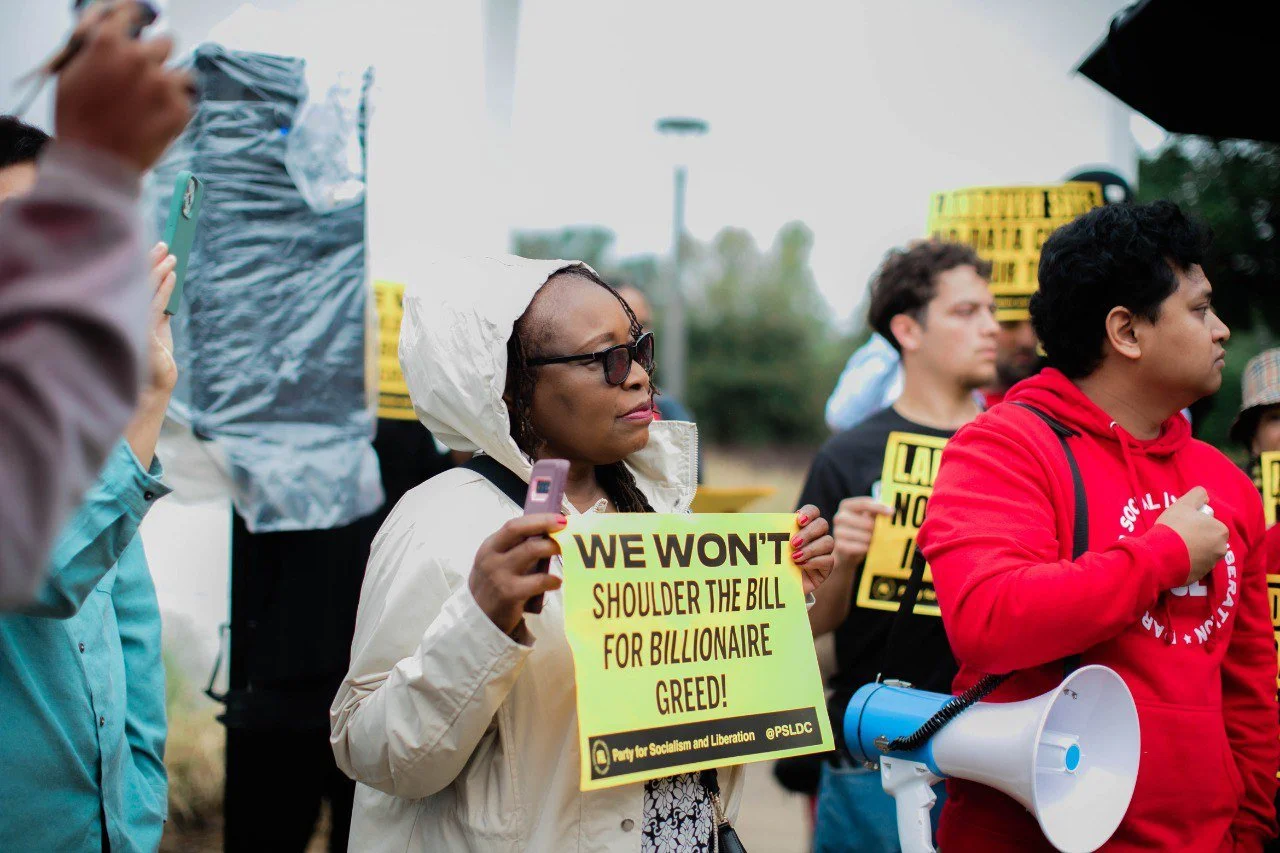
Hundreds of Prince George’s County residents rallied against the proposed data center in Landover, MD on Sept 11, 2025. Photo courtesy of Party for Socialism and Liberation - DC.
VERNICE MILLER-TRAVIS: And some of them sacrificed right here in Prince George's County. There's a subdivision very close by where I live called Lake Arbor. The place is lovely, but what I can't understand is, why is the subdivision named after the tobacco plantation that it used to be?
I think it's important to know that our people were here. Our people probably came off the slave ships in Annapolis, Maryland. Annapolis was one of the largest slave markets and ports on the eastern seaboard.
The last thing I want to say, and it’s making me emotional—
E.N. WEST: I feel it too—
VERNICE MILLER-TRAVIS:—Is that my husband and I used to drive to the nearest Whole Foods store in Annapolis, MD a couple times a week. And E, every time we went we would drive through the back roads through the neighboring city called Davidsonville, Maryland. Davidsonville, Maryland, used to be a sundown town. In other words, if you were a Black person and you were there after sundown, you were taking your life into your own hands. My husband is buried in Davidsonville, Maryland. I hope he forgives me for that.
But every single time we drove there and back, Charles would say, I can feel the ancestors. And I felt that he knew what he was talking about, E, because his family, his grandfather, and grandmother, they bought the plantation on which the Travis family had been enslaved.
So, when he said that I could feel the ancestors, I thought he might know what he was talking about. He experienced what it was like to live with the spirit of your ancestors when he would go down from New Jersey in the summers and visit the family home and farmland and cemetery in Lawrenceville, VA.
“Until I moved to Maryland, I did not have a sense of how you could reach out and touch the ancestors...”
He had a sensitivity to where the ancestors, the spirits are, and it gave me an appreciation too. Until I moved to Maryland, I did not have a sense of how you could reach out and touch the ancestors because they are buried in unmarked graves and cemeteries all around here in Prince George's and Anne Arundel County.
The presence of slavery, the presence of Jim Crow, is here in the soil, in the buildings, in the churches that are still standing since the late 1600s, in the old schools, in the old farms. History is alive in this place. Black history is alive in this place. And so, our ancestors are watching.
What happens here is important. It’s important for those of us who live in this county, but it's also important for the future of our state. So often, conversations on AI data centers are technical. But the impact isn’t just environmental and physical—it’s spiritual too.
I did not know that this place existed. Living here has made me so much better at everything that I do, what I eat, how I sleep. I’m a better writer. I'm a better strategist. I live in a major migratory path for birds, so I see the most amazing birds. I have deer because I don't put chemicals on my grass, so the grass is sweet, so they come, and they look up at me as they’re eating, and then they go back to what they're doing because they know they're safe, right? There’s just not another place like this. There just isn't. And I'm prepared to fight for every inch of it.
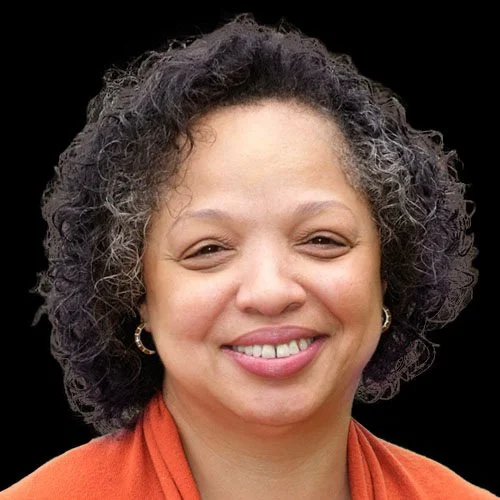
Vernice Miller-Travis is one of the nation’s pioneers, leading experts, and most respected thought leaders on environmental justice. Vernice consults for federal and state agencies, foundations and nonprofits. Prior to becoming a consultant, she established the environmental justice initiative for NRDC and as a Program Officer, initiated the environmental justice grantmaking portfolio for the Ford Foundation. Vernice has extensive experience working with communities that have undergone economic disinvestment and environmental degradation by facilitating community-based planning and implementing community revitalization and sustainable redevelopment initiatives and projects.
Vernice is the co-founder of WeACT for Environmental Justice and serves on its board. She is also an appointee of Gov. Wes Moore to the board of trustees of the Chesapeake Bay Trust foundation. She also serves on the boards of Clean Water Action/Clean Water Fund, Land Loss Prevention Project, National Community Reinvestment Coalition, Natural Resources Defense Council’s Action Fund, Patuxent Riverkeeper, and on the advisory boards of Green Leadership Trust, and Imani Energy. In 2024, Vernice Miller-Travis was awarded the prestigious William K. Riley Lifetime Achievement Award by the American University School of Public Policy.
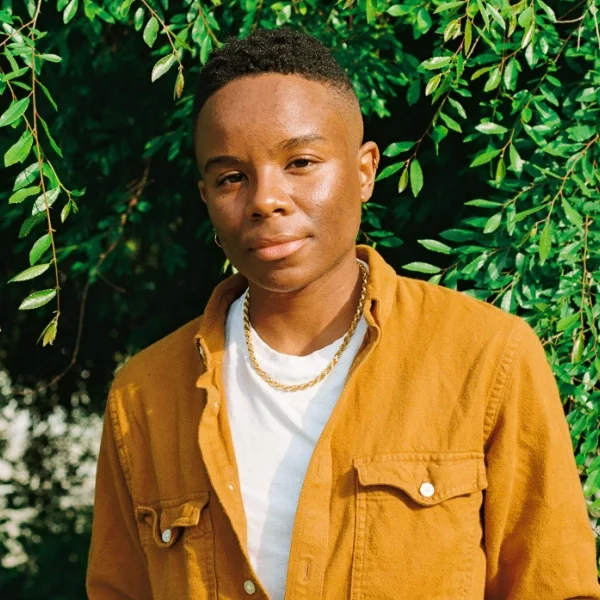
E.N. West, affectionately known as "E", proudly hails from the DC metropolitan area, by way of Alexandria, Virginia. E deeply believes "we are uninhibited when we know our power" and is committed to co-creating a world where everyone intimately knows how powerful they are and directs that power toward collective liberation. E is many things, but at the heart of all of them, they are a community organizer based in Seattle, Washington.
Peace & Riot is made by real people — not AI.
Journalists, photographers, editors, and contributors doing original reporting from the frontlines.
That work is under threat. Newsrooms are shrinking. AI is training itself on what journalists have already built, and replacing it with something hollow.
Independent, human storytelling is being squeezed from every direction. If you value work built on lived experience, not stolen data — help keep it alive.
Donate to power more issues like this one.